

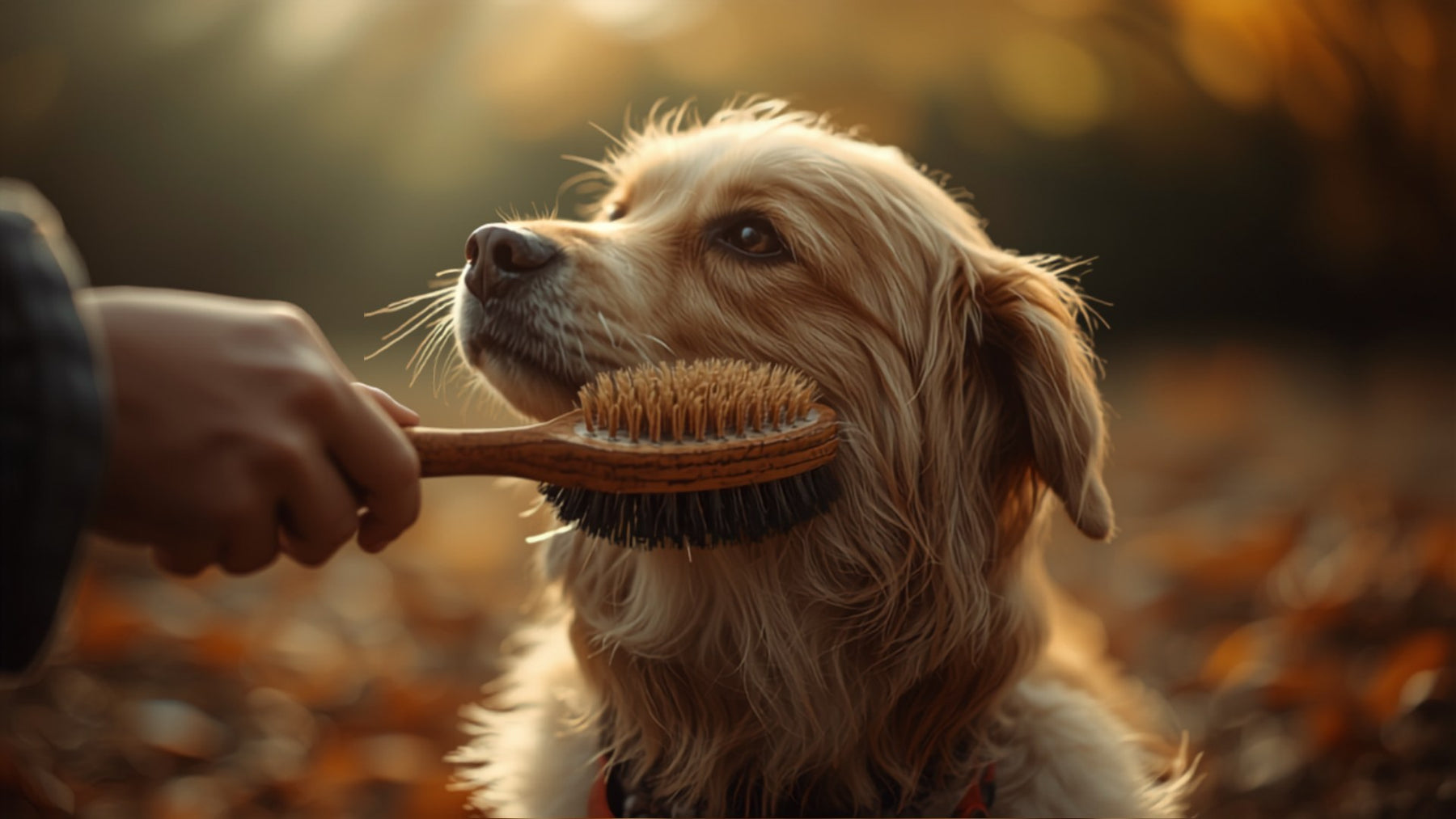
When hair suddenly seems to be everywhere in September, caught in the coat or covering the sofa, that is perfectly normal for most dogs and cats. Autumn shedding is a natural process that prepares animals for winter. Still, it helps to know what is normal, how you can support them and when increased hair loss really is a reason to see a vet.
Why dogs and cats change their coats in autumn
Shedding is triggered primarily by day length rather than temperature. As days grow shorter, the body registers this through the retina and adjusts hormone levels. In response, a denser winter coat with more undercoat grows in while some of the summer coat falls out. In animals kept entirely indoors, which experience little change in daylight and live in heated rooms all year, this rhythm can shift or weaken, though it rarely stops altogether.
Autumn shedding runs in the opposite direction to spring shedding: in spring, the dense winter undercoat is replaced by a lighter summer coat; in autumn, the reverse happens. Both processes are demanding because metabolism changes alongside the visible shedding. That explains why some animals seem a little more tired or eat more than usual during this time.
What is normal
- Increased shedding for four to six weeks
- Noticeably more undercoat when brushing, especially in double-coated breeds
- An overall denser and often slightly duller coat during the transition
- In cats, a slightly higher risk of hairballs because more loose hair is swallowed during grooming
When to look more closely
Not all autumn hair loss is harmless shedding. Take notice of bald patches without regrowth, red or flaky skin, constant scratching or licking of one area, and hair loss continuing unabated for more than six to eight weeks. Possible causes include parasites such as fleas or mites, food allergies, thyroid problems or simply stress, perhaps after a move or a new family member arriving. In all these cases, no guide can replace a veterinary examination, but an early appointment often prevents a small problem becoming a prolonged one.
How to support shedding sensibly
The brush does most of the work. Short-haired dogs and cats manage with once or twice a week. With a dense undercoat, as in the German Shepherd, Husky or Maine Coon, three to four sessions are needed during the moult, otherwise the second layer mats before the first is through. The tool is what counts: an undercoat rake pulls the loose hairs out from deep down, a normal brush just glides over the top. With cats this has a benefit that has nothing to do with the sofa. What you comb out, she does not swallow when grooming. In cats, retching during the moult can point to swallowed hair. If your cat retches more than now and then, have it checked. If a dog retches repeatedly without anything coming up, that is not a coat problem: together with a bloated belly and restlessness, it can be gastric torsion. That is an emergency, so go to the animal hospital immediately.
Repeated retching without result is a warning sign in cats and needs to be seen by a vet practice soon. With breathing difficulty, listlessness or a clearly poor general condition, go straight to the vet practice or the emergency service.
There is a persistent idea that something extra must be added to food during shedding. In most homes, that is not true. Food labelled as complete already meets protein and fatty acid requirements in full by definition; that is exactly what the label means. Extra oil or biotin therefore helps only where a deficiency actually exists, and that is diagnosed by a vet using blood tests, not from the sofa. More fat in the bowl is also extra energy rather than a harmless surplus, and an animal already getting little exercise will put it on around the waist. If the coat stays dull despite a good diet, that calls for an appointment rather than a new powder.
From October, another factor appears that you cannot see on the animal. Once the heating is on, indoor humidity drops, and dry air makes skin and coat brittle. Briefly opening windows wide helps, as does a humidifier. Bathing rarely helps: an extra bath washes out precisely the oils the skin needs at this time. Vacuuming and wiping sleeping areas are more effective against hair around the home than any shampoo anyway.
In older animals everything takes longer. The metabolism works more slowly, the new coat grows back more sluggishly, and the moult is often more noticeable than in younger years. With them it is worth keeping an eye on weight and activity, because both can quietly tip during this time. At the other end is the first real moult, when the soft juvenile coat gives way to the adult coat. According to the American Kennel Club, in dogs this usually happens at four to six months, but depending on the breed it can be earlier or only around the first birthday, and in some breeds it takes even longer until the adult coat is fully there. Kittens also swap their juvenile coat; exactly when varies from cat to cat. It often looks dramatic and usually is not. Bald patches, reddened skin or severe itching, however, belong at the vet's.
The difference between dogs and cats is less about the process than its pace. A Husky visibly loses clumps within a few days. An indoor cat sheds a little all year and may look barely different in autumn than in June because the changes in daylight are missing. Four to six weeks is normal in both cases. With a very dense undercoat or early matting, a single thorough brushing session with a groomer noticeably shortens the process. The appointment is not essential, but it is pleasant nonetheless.

And for a portrait?
By the way, the autumn moult is not a good time for the source photo of a pet portrait, because the coat often looks uneven and dull during this period. If you have time anyway, you can wait for the denser winter coat. It is not necessary, though: a sharp, well-lit photo of a well-groomed coat is enough as a template.
Whether summer or winter coat: what matters for a portrait is sharp eyes and good light. The pet portraits for dogs, cats and horses are available in a wooden frame, on canvas, on acrylic glass and as a poster.
To find your pet’s age in human years, try our dog age calculator or our cat age calculator .
You can find more about everyday life with dogs and cats, along with colouring books for children, on our books page (book in German).
Further reading
- An older dog, new rules: why older animals take longer
- Maine Coon: ten kilos of cat in everyday life: when there is plenty of fur involved
- Labrador Retriever: why a quarter are always hungry: a classic among heavy shedders


