

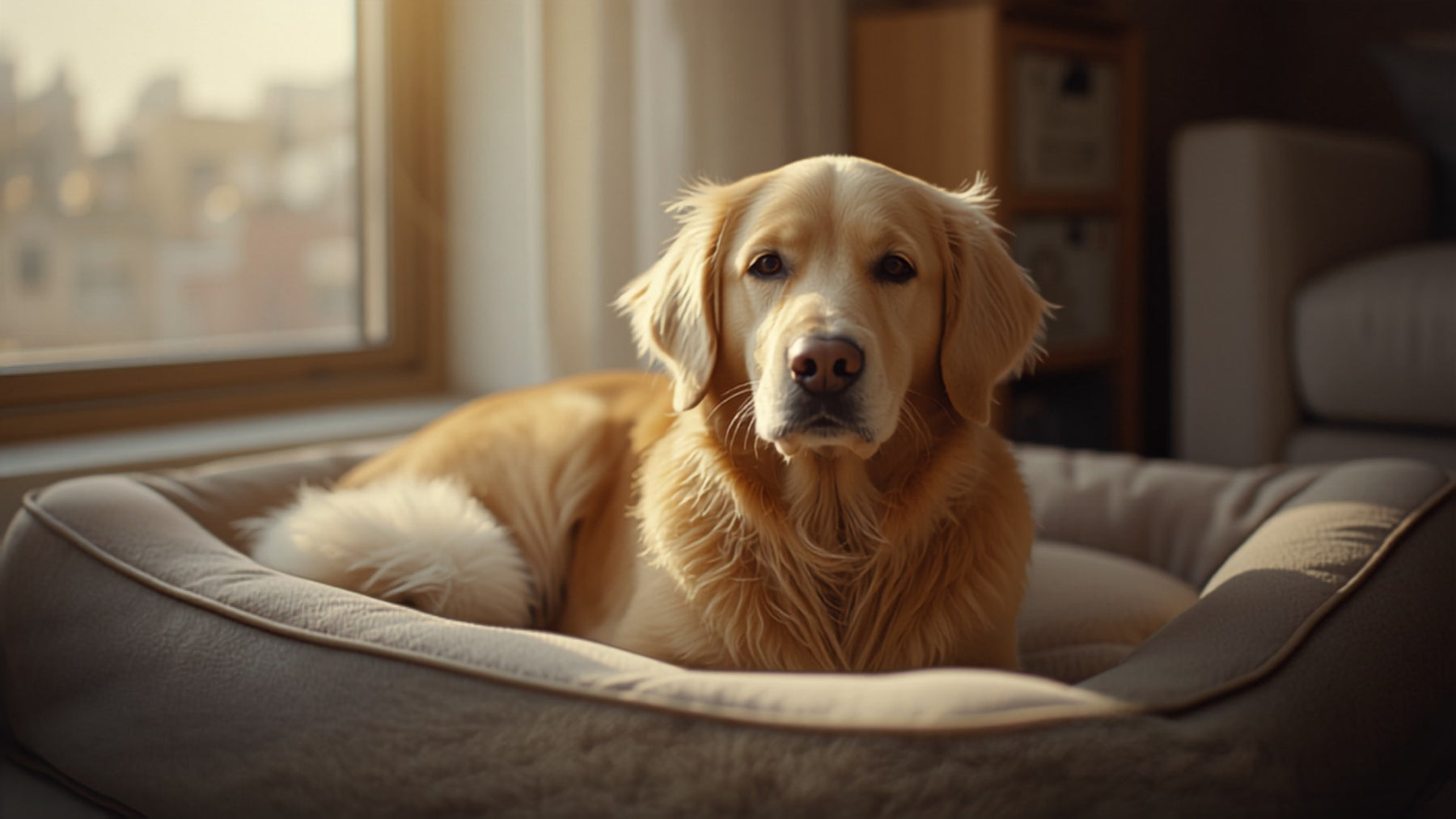
You do not notice it all at once. First come the stairs your dog no longer bounds up. Then the grey spreading from the muzzle to the eyebrows. Then the moment you call their name and get no response, not out of stubbornness, but because they did not hear you. And then you are sitting on the floor beside a dog who was a puppy only yesterday, realising: they have grown old.
This is not a sad article. It is about making these years good. An old dog is not a broken dog. They need different things from before, and in return they give you something no puppy can: the quiet companionship of someone who knows you completely.
When is a dog considered old?
That depends on size. Small breeds are considered seniors from around ten years, medium breeds from eight, and large and giant breeds from as early as six. A twelve-year-old Chihuahua is enjoying retirement; a Great Dane of the same age is a rarity. More useful than the number is what you see: how does your dog move in the morning? How quickly do they recover after a walk? How well do they maintain their weight?
What changes in the body
Joints
Osteoarthritis is common in older dogs, and many hardly show any pain because dogs often bear it quietly. Signs include stiffness after resting, hesitation at stairs or before jumping into the car, shorter strides and licking a joint. This is a reason to act rather than give up: the vet's practice can suggest pain relief and other treatments, physiotherapy can help many dogs, and exercise remains important. It simply needs to change: several short walks instead of one long outing, swimming instead of chasing balls.
Senses
Hearing and vision decline. A dog with poorer hearing is more easily startled when touched while asleep. Speak before touching them, or step firmly enough for them to feel the vibration. Hand signals introduced early still work when hearing no longer does. For declining vision, leave the furniture where it is. Older dogs know their home by heart.
Mind
Yes, dogs can develop dementia. Cognitive dysfunction syndrome can cause restlessness at night, disorientation, staring into corners and loss of housetraining. Foods with special supplements and medication can ease the symptoms in some dogs. Whether that is an option for your dog is something the vet's practice will clarify. So can structure: regular times, familiar routes and little change. A dog with dementia is still your dog; they simply need more reassurance.
Organs
Kidneys, heart, thyroid, liver. In the early stages, many problems only show up in laboratory tests. A senior dog should therefore have regular check-ups: the US veterinary association AAHA recommends a complete blood count, blood chemistry and urinalysis every 6 to 12 months for older dogs. The blood count examines blood cells; kidney and liver values are part of blood chemistry. How well kidney disease can be treated depends on the stage and the individual dog. The earlier it is detected, the more options you have.
What to adjust
- Food. There is no single senior diet for every dog. Whether your dog needs fewer calories, more or less protein, or joint supplements depends on weight, muscle mass and test results. Healthy seniors do not need protein restriction, although it may be useful from a certain stage of kidney disease. Discuss food and supplements with your vet. The best-known long-term study on weight shows how much it matters: 48 Labrador Retrievers were followed from eight weeks of age until death, with one half of the pairs receiving a quarter less food throughout their lives. This group lived significantly longer in median terms than the comparison group. The study does not tell us how much an already overweight senior would benefit from losing weight, and it covers only one breed. But it is the best reason to take weight seriously: one extra kilo is ten percent of a ten-kilo dog.
- Sleeping space. An orthopaedic bed, away from cold flooring and somewhere your dog does not have to get up three times a day to let someone pass. Older dogs sleep considerably more than before. They need a place where they can do so undisturbed.
- Flooring. Laminate and tiles become slippery. Put runners along the main routes, use a ramp for the car and try non-slip socks on difficult days.
- Walks. Short, frequent and slow. Let your dog sniff for as long as they like. For an older dog, sniffing is what reading the newspaper is for us.
- Mental exercise. Searching games, a snuffle mat, little tricks performed lying down. Many older dogs visibly perk up with this.
What to avoid
Protecting your dog so much that they stop moving. Comforting them with treats until they become overweight. Punishing accidents indoors as bad behaviour. Leaving them alone because they sleep all the time anyway. Older dogs need closeness more than ever. Not because they are helpless, but because you are their point of reference as the world becomes quieter and less clear.
The question of goodbye
Eventually the question comes, and many owners fear it years before it arises. One thought can help: more good days than bad. As long as your dog eats, is happy to see you and enjoys going outside, even if only as far as the next corner, those are good days. When the bad days outnumber them, you will know, and your vet will help you stay honest. This subject deserves more than a paragraph, so we discuss it in detail in Saying goodbye to your dog.
Why these years can be the best
An old dog has nothing left to prove. Many things that once mattered no longer interest them. They lie beside you and are simply there, and when you look at them, they look back with that gaze that says: I know you. All of you.
An old dog’s face is the most rewarding subject there is for a photograph. Grey muzzles, cloudy eyes, an ear that no longer stands quite right, and a whole lifetime in every one of these lines. If you want a photo of your senior, take it now. By the window, in the afternoon light, in their favourite spot. Not for later. For now.

A grey muzzle does not need perfect light; it deserves a grand setting. In a wooden frame on the wall, that look will still be there when one day your dog is no longer with you. When you order, you already see your design in the live preview; if you have a special request, you get a personal preview by e-mail before printing.
For more reading during this stage, you can find all our books together on the books page (books in German).
Our dog age calculator works out your dog’s age in human years according to size.
Further reading
- Autumn shedding: what else changes with age
- New Year’s Eve anxiety in dogs: seniors are more sensitive to noise
- Saying goodbye to your dog: when time is running short
Source on weight: Kealy R.D. et al., Effects of diet restriction on life span and age-related changes in dogs, Journal of the American Veterinary Medical Association 220 (2002), pp. 1315 to 1320 (Purina Life Span Study, 48 Labrador Retrievers). Accessed on 27.10.2026. This article does not replace veterinary advice.


