

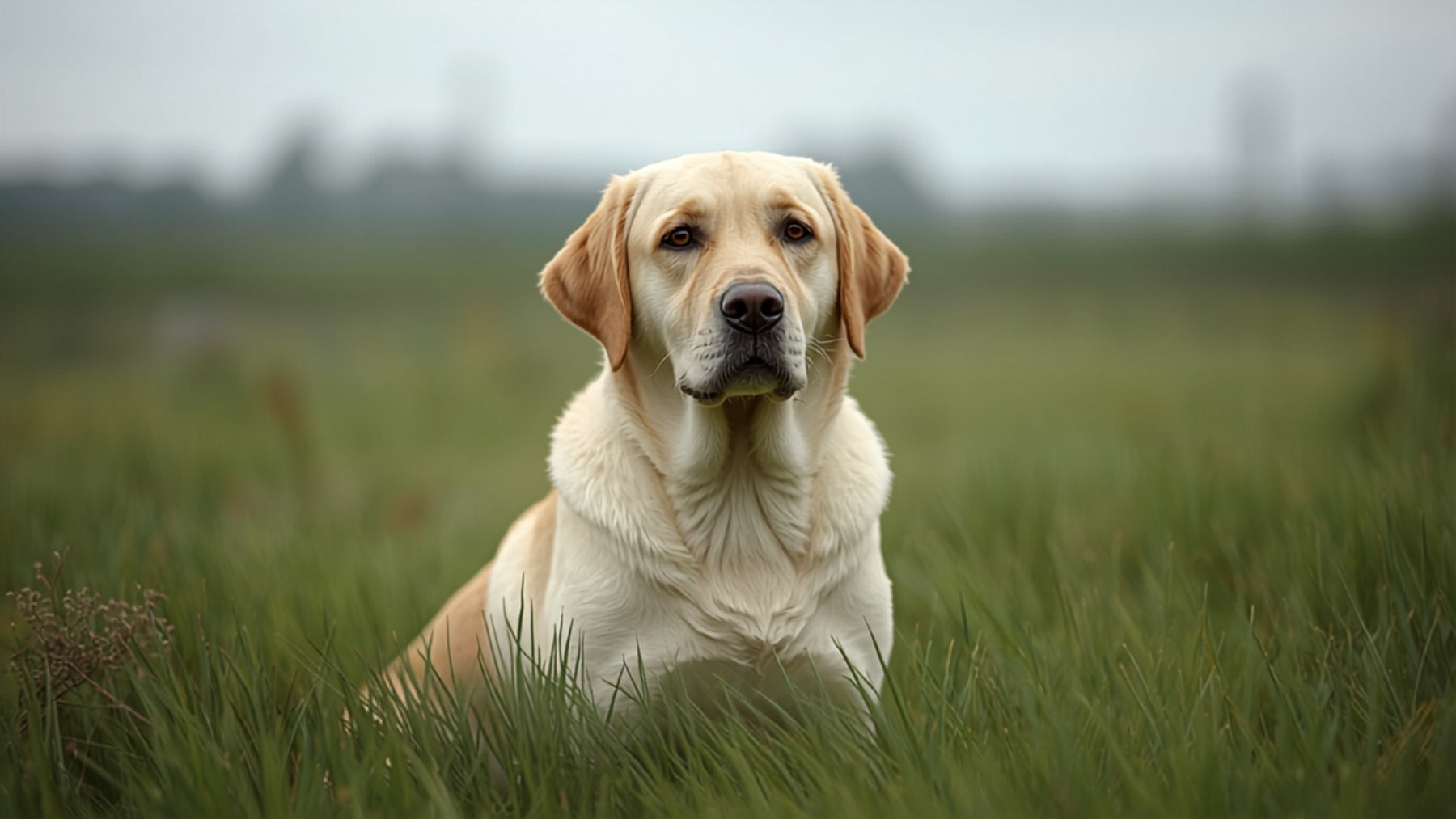
There is a moment almost every Labrador household knows. The dog has just eaten, and two minutes later he is back at the bowl, looking as if nobody has paid him any attention for days. For a long time this was seen as a character trait. Since 2024 there has been a better explanation.
The video
Clicking loads the video from YouTube. Data is transferred to YouTube (Google) in the process. Privacy policy
A University of Cambridge team led by Eleanor Raffan published a study on Labrador Retrievers in March 2024. Dogs with a change in the POMC gene burn around 25 per cent fewer calories at rest than dogs without this variant, and they show much more drive around food. The gene variant is common in Labradors and even more frequent in the closely related Flat Coated Retriever: according to the study, the frequency of the variant in the genome (allele frequency) is 12 per cent in Labradors and 60 per cent in Flat Coated Retrievers.
That doesn't take any responsibility off you. But it does explain why, in this breed of all breeds, "he just loves his food" is not a harmless remark.
Key facts
- Height at the withers: males 56 to 57 cm, females 54 to 56 cm (VDH breed standard, accessed on 19.09.2026)
- Weight: in practice 25 to 36 kg. The breed standard does not specify a weight.
- Coat: short, dense, water-repellent, sheds all year round
- Origin: Newfoundland and Great Britain, bred for retrieving from water
- Character: people-oriented, keen to work, cooperative, highly food-motivated
How long does a Labrador live?
Two large British analyses come to different results. The VetCompass life tables from the Royal Veterinary College from 2022 give 11.8 years for the Labrador, against an average of 11.2 years across all dogs. An analysis of more than 580,000 dogs from 2024 arrives at a median of 13.1 years. The difference comes down to the data and the method, not to the breed having become healthier within two years. There are no reliable German figures on this scale.
Love of work is not a marketing term
The Labrador was bred to retrieve for hours in wind and water. The VDH describes the breed in terms of willingness to work, steadiness and stamina, and names close family contact and a great deal of exercise as conditions for keeping one. That is not an extra, it is the condition.
What works: dummy work, scent work, swimming, tracking, shared tasks that use head and body. What doesn't work: an hour of throwing sticks in one go. A Labrador doesn't stop exercising of his own accord. He keeps going until his body gives up, and he is the last to notice.
That is why keeping him busy also includes the opposite of action. A Labrador who has never learnt that sometimes nothing happens at all becomes restless in the house instead of relaxed. Two hours of exercise a day plus mental work is a good guide for many healthy adult Labradors; how much exactly suits yours depends on age, fitness and recovery.
Weight is the biggest health issue
In a Labrador, being overweight is not a cosmetic problem. Every extra kilo puts strain on the hips and elbows, and that is exactly where the breed's known weak spots lie: hip dysplasia (HD) and elbow dysplasia (ED). Both have hereditary components, but are made considerably worse by excess weight and the wrong kind of strain during growth.
What you want to see at the breeder's: for breeding approval, the Deutscher Retriever Club requires an HD and ED assessment by recognised experts, an eye examination by a recognised ophthalmologist, a DNA profile and breed-specific gene tests. Ask to be shown the parents' results, not told about them. Anyone who dodges the question doesn't have them.
In everyday life something unspectacular decides it: you must be able to feel the ribs with light pressure. Weigh portions instead of guessing. Subtract treats from the daily ration, don't add them on top. With a dog who burns fewer calories and feels hungrier, in the long run the measuring cup wins, not good intentions.
The uncomfortable part
On 28 August 2024 the Deutscher Tierschutzbund (German Animal Welfare Federation) published a survey of its member shelters. 69 per cent reported at least very high occupancy, 49 per cent were full or overfull, and only 18 per cent had any capacity left at all. 82 per cent had recorded rising animal numbers since 2022. As reasons for giving animals up, the federation names being overwhelmed, lack of time, biting incidents and higher vet costs.
There are no nationwide statistics on which breeds are in German animal shelters (checked on 19.09.2026). All that can be shown is this: in the VDH puppy statistics the Labrador ranks fourth with around 2,300 registered puppies, and the two most common reasons for giving a dog up are being overwhelmed and lack of time. Our assessment, nothing more: those are exactly the two points at which a dog with this need for exercise and activity tips over. If you are looking for a Labrador, it makes sense to ask at the shelter and at breed rescue first, before you reserve a puppy.
What he costs
A puppy from a recognised breeder costs around 1,200 to 2,000 euros in Germany, and more depending on the club and line (market observation from breeder and portal listings, accessed on 19.09.2026, not official statistics). Ongoing costs add up to: 50 to 100 euros of food a month, 10 to 20 euros of treats, 10 to 20 euros of parasite protection, plus 30 to 150 euros a year in dog tax depending on the municipality and 200 to 600 euros for health or surgery insurance.
If you are still torn between several breeds: in our book „Welcher Hund passt WIRKLICH zu dir?“ we go through exactly this decision, without breed romanticism.
Frequently asked questions
Is the Labrador a good dog for beginners?
He forgives training mistakes more easily than most breeds, because he is cooperative and likes to work with you. He doesn't forgive boredom. For beginners with time he is a good fit, for beginners without time he is the wrong choice.
Can a Labrador live in a flat?
Yes. He doesn't care about square metres, but he does care about your diary. What matters is what happens outside, and whether he is allowed to switch off indoors.
How bad is the shedding really?
All year round, with two heavier phases a year. Short fur doesn't mean little fur, it just means short hairs that work their way into fabrics. A thorough brushing once a week reduces it noticeably, but doesn't end it.
Why is he unsuitable as a guard dog?
Because he basically assumes strangers are visitors. He might announce them, but he won't defend anything. That isn't a training mistake, it's the breeding goal.
If you want him on the wall

On phone photos a black Labrador almost always disappears into his own coat. In the style of an oil painting the opposite happens: the highlights on the forehead, the bridge of the nose and the chest come back, and suddenly you can see again where the dog ends and the background begins. Send us a photo, we'll show you a preview first, and only once it's right do we print. We adjust the design until you're happy. You can choose from poster, canvas, wooden frame and acrylic glass. 20 % of our profit goes to animal welfare.
Are you just moving in with a Labrador puppy? Our free puppy starter pack takes you through the first month with a shopping list, a 4-week plan and an emergency page.
Read on
- Golden Retriever, the direct comparison, more sensitive and with a different health profile
- Border Collie, if two hours of exercise is too little of a job for you
- Dachshund, the complete opposite in miniature
- Puppy training: the 5 rules, because with a Labrador food guarding needs sorting out early
Sources, accessed on 27.10.2026: Dittmann MT et al., Low resting metabolic rate and increased hunger due to β-MSH and β-endorphin deletion in a canine model, Science Advances 2024; Raffan E et al., A Deletion in the Canine POMC Gene Is Associated with Weight and Appetite in Obesity-Prone Labrador Retriever Dogs, Cell Metabolism 2016; Teng KT et al., Life tables of annual life expectancy and mortality for companion dogs in the United Kingdom, Scientific Reports 2022; McMillan KM et al., Longevity of companion dog breeds: those at risk from early death, Scientific Reports 2024; Deutscher Tierschutzbund, press release „Tierheime überfüllt“ of 28.08.2024.
The links to our books are affiliate links. If you buy through them, you support us at no extra cost to you.


