

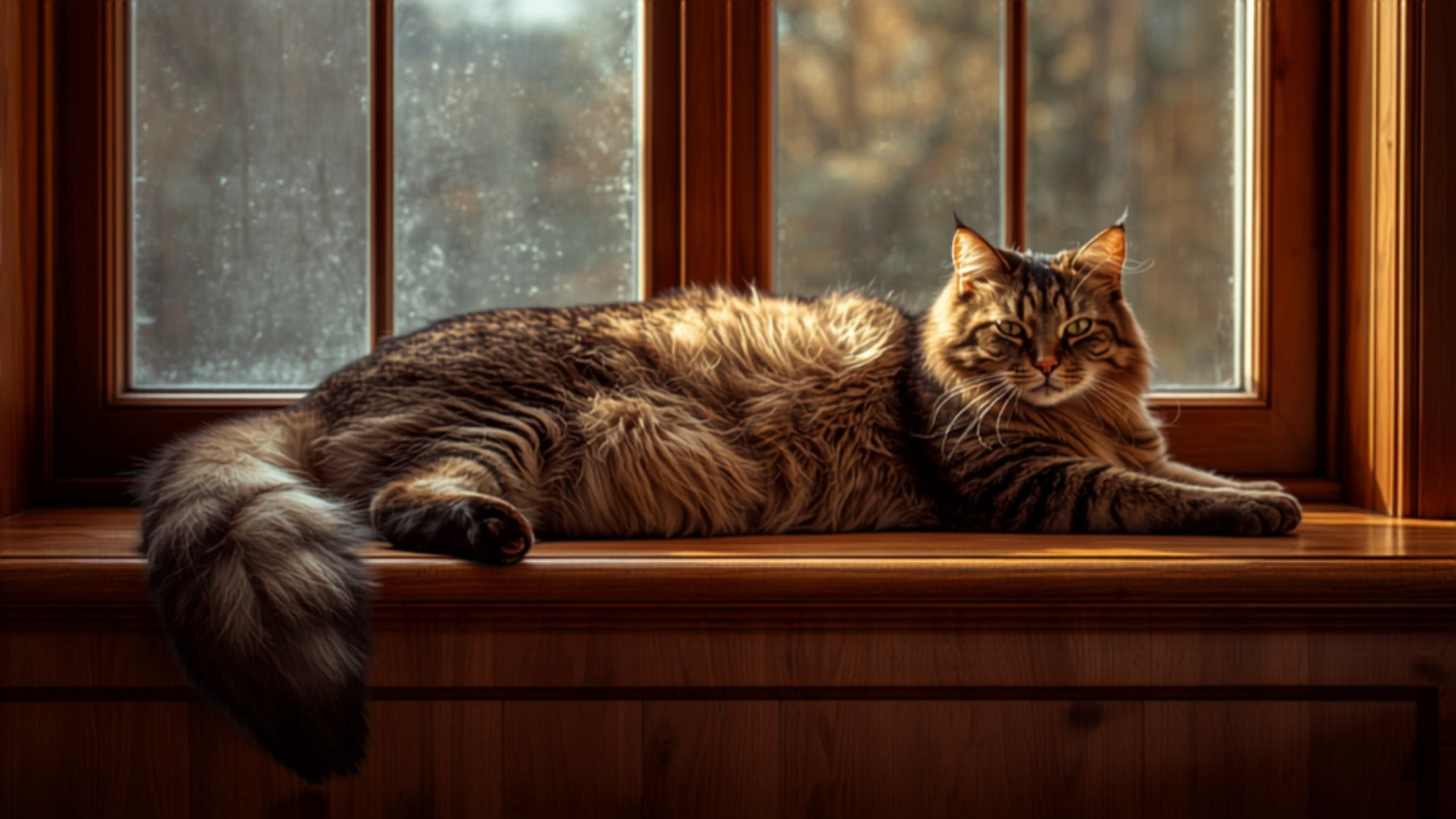
Every Maine Coon owner knows the moment: visitors arrive, the cat enters and someone says, “What on earth is THAT?” A male weighing eight, nine, sometimes ten kilograms, with lynx-like ear tufts, a tail like a feather plume and the look of someone who bought the house. Then this enormous animal rolls onto its back and asks for a tummy rub.
The video
Clicking loads the video from YouTube. Data is transferred to YouTube (Google) in the process. Privacy policy
The Maine Coon is the largest domesticated cat breed and also one of the friendliest. That combination explains its popularity. But this is no sofa cushion. Here is what to know before you fall in love.
Maine Coon in figures
- Origin: the US state of Maine, a natural breed developed from farm cats
- Weight: males 6 to 10 kg, females 4 to 6 kg. Not fully grown until 3 to 4 years
- Life expectancy: 12 to 15 years
- Coat: semi-long, water-repellent, with a ruff and feathering on the hind legs
- Temperament: sociable, playful, talkative and affectionate in a dog-like way
Temperament: the dog of the cat world
Maine Coons follow their people from room to room. They come when called, usually. They play fetch, many seriously and for long stretches. They sit beside you while you work, commenting with a high chirp you would not expect from such a large animal. They rarely meow but trill and coo constantly.
They are not pushy, but want to be involved. A Maine Coon left alone all day rarely becomes destructive; many quietly withdraw instead. That is why responsible breeders almost always place kittens in pairs or in homes with an existing cat.
What size means day to day
1. This is a big cat. Really big.
That sounds obvious until the DIY-store cat tree topples at the first jump. Maine Coons need cat trees with thick posts and resting platforms at least 50 cm in diameter, an XXL litter tray rarely found in shops and carriers actually designed for small dogs. Expect initial equipment to cost twice what you would spend for an ordinary cat.
2. The coat takes work, but it is manageable
Unlike a Persian’s coat, a Maine Coon’s does not mat immediately. Brushing twice a week is usually enough, more often under the forelegs and around the hind-leg feathering. The challenge is the volume rather than the brushing itself: during shedding, fluff is everywhere. If anyone in the family has allergies, test beforehand rather than afterwards.
3. Health: HCM and hips
Hypertrophic cardiomyopathy is the Maine Coon’s most common inherited disease. A genetic test exists for one known mutation, but it does not replace a heart ultrasound. Responsible breeders regularly scan their breeding cats and show you the results. At this size, susceptibility to hip dysplasia is another concern, alongside spinal muscular atrophy; tests are available for these too. Ask about them. Anyone who evades the question is out.
4. Costs do not end at purchase
A kitten with pedigree papers and health testing costs 1,200 to 1,800 euros. Afterwards, a ten-kilogram male eats almost twice as much as an ordinary domestic cat, medication is dosed by weight, and cat insurance is a serious consideration for this breed. Anyone with a tight budget needs an honest calculation.
5. They remain kittens for a long time
Maine Coons do not mature physically and mentally until three to four years of age. Until then, you have a kitten the size of a Dachshund thundering around the flat at night and pushing things off shelves because it can. Charming, if you are prepared.
Care: what they need
- Company. A second cat or a cat-friendly dog. Non-negotiable for owners who go out to work.
- Vertical space. Climbing opportunities matter more than floor area: wall shelves, a sturdy cat tree and a window spot.
- Water. Many Maine Coons love water, play with drinking fountains and watch you shower. A fountain encourages adequate drinking, supporting kidney health.
- Secure outdoor access or a balcony. Not essential, but a benefit. Unrestricted roaming is unwise with this breed because of the risk of theft.
Who is a Maine Coon right for?
For people who actually want a dog but are cat people. For families with children, because many Maine Coons are very patient. For everyone who wants a cat that shares their life rather than just shares their home. Less suitable for people who cannot create space for climbing in a small flat, for a tight budget or for anyone wanting an unobtrusive cat.
Frequently asked questions
Can a Maine Coon be kept as an only cat? If someone is home all day, yes. Otherwise, a pair is better.
Are Maine Coons lap cats? Many are, but ten kilograms on your lap is an experience. Many prefer lying beside you with a paw on your leg.
Do they get along with dogs? Often well, especially when they grow up together. How it works out depends on both animals, though.
The Maine Coon as a portrait subject
Few cats bring as much texture to a picture as a Maine Coon. The ruff, tufted ears and alert expression give depth to every style, from classic oil style to a Royal portrait. A photo tip: shoot from slightly below to convey the size, with daylight from the side to bring out the coat’s texture.

A large cat can carry a larger format too, and there are suitable sizes for smaller walls. In a wooden frame, the oil painting gets the space the animal deserves, and you can see in advance how it looks with your photo. The sizes are listed under Cat portraits.
Find name ideas for your Maine Coon, each with its meaning, in our cat name finder.
Our book “Which Cat REALLY Suits You?” helps establish whether a Maine Coon fits your routine. Find it on our books page (book in German).
Further reading
- British Shorthair: the cat beside you: a more compact, lower-maintenance cat
- Ragdoll: a gentle giant with a heart concern: similarly large and similarly gentle
- Autumn shedding: no minor matter with this coat


