

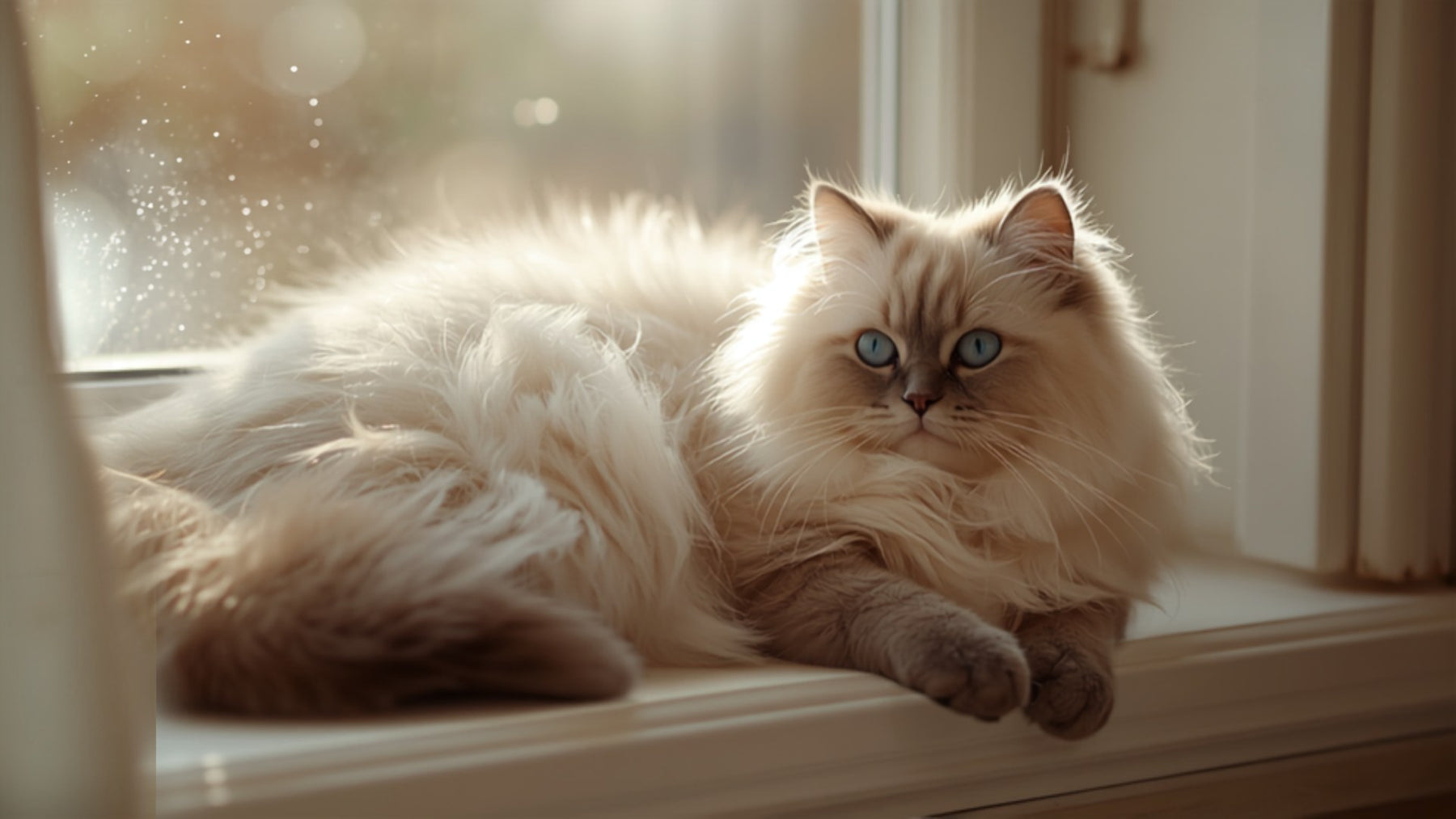
Pick one up and they literally go limp like a rag doll, hence the name. The Ragdoll is one of the largest and calmest domestic cat breeds: blue-eyed, semi-longhaired and sometimes more dog-like than cat-like in their affection. That temperament makes them popular, but brings a few misunderstandings worth knowing before getting one.
Ragdoll at a glance
- Origin: California, USA, bred since the 1960s
- Size: Males up to 9 kg, females 4 to 6 kg; one of the heaviest domestic cat breeds
- Coat: Semi-long, silky, little undercoat, less prone to matting than other longhaired breeds
- Life expectancy: 12 to 17 years
- Temperament: Calm, affectionate, gentle, people-oriented, with little hunting drive
Temperament: the cat who follows along
Ragdolls actively seek closeness to their people. They follow from room to room, sit beside you while you work on a laptop and greet you at the door. Rarely loud, they meow little and often seem strikingly relaxed, almost sleepy. They generally get on well with children and other pets because confrontation is foreign to them. Their hunting drive is low compared with many breeds, making them particularly straightforward indoor cats if they have enough to do.
This calmness is sometimes romanticised. A Ragdoll has boundaries, but expresses them more quietly than other cats. Ignoring those subtle signals still overwhelms them.
The breed developed in California in the 1960s from semi-longhaired domestic cats, selected specifically for calmness and affection. This relatively recent breeding history also explains why genetic diversity is lower than in old natural breeds, which in turn helps explain why inherited diseases such as HCM remain relevant in the population.
Five points before getting a Ragdoll
1. HCM is the biggest health concern
Hypertrophic cardiomyopathy is an inherited heart disease in which the heart muscle thickens, often without visible symptoms for years. A known genetic mutation can be tested for in Ragdolls, although the test does not cover every case. Reputable breeders also arrange regular heart ultrasound examinations for breeding cats. An annual veterinary check is sensible for this breed, even when the cat seems completely healthy.
2. Keep PKD in mind
Polycystic kidney disease, in which cysts form in the kidneys, occurs less often in Ragdolls than in Persians, for example, but does occur. Ultrasound can detect it even in kittens. Ask about the parents’ examination results before buying; a reputable breeder will share them openly.
3. Weight creeps on faster than expected
A calm temperament has a downside: adult Ragdolls often move considerably less than other cats and are therefore prone to excess weight. That adds strain to joints and heart. Daily active play and measured, needs-based feeding are basic requirements for this breed.
4. Easier care does not mean no care
It is true that a Ragdoll’s coat mats less often than other longhaired cats’. Still, brushing is necessary, particularly on the belly and hind legs where knots otherwise form. Two to three brushes a week are usually enough, more during spring and autumn shedding.
5. The price of health has a reason
A Ragdoll kitten from a breeder affiliated with a recognised association such as TICA or a German breed club, who can provide the parents’ HCM and PKD tests, usually costs 800 to 1.500 euros. Much cheaper cats without pedigree papers or health testing carry a real risk that those two diseases have been passed on undetected.
The breed also typically has coloured markings on the face, ears, paws and tail against a pale body: the colourpoint pattern familiar from Siamese cats. Kittens are born almost white, with their final colour developing over weeks and months. A Ragdoll often reaches full maturity only after three to four years.
Care: what they really need
- An entirely indoor life is possible. Low hunting drive makes outdoor access optional rather than necessary.
- Active play every day. To counter the tendency to gain weight and provide mental activity.
- Regular brushing. Two to three times a week, more during shedding.
- Social contact. Ragdolls are strongly attached to their people and are not cats for long, lonely days.
- Provide high retreats too. Even a calm cat needs somewhere to be undisturbed.
Who does the Ragdoll suit?
People who spend plenty of time at home, work from home or want a calm, affectionate family cat. First-time cat owners, because the temperament holds few surprises. Less suitable for people regularly away for long periods or anyone who prefers an independent, distant cat.
A Ragdoll can fit well into a home with dogs too, provided introductions are gentle. Their limited flight instinct and general calmness mean conflicts escalate less readily than with more nervous breeds. Every introduction must still happen slowly and under supervision.
Frequently asked questions
Do Ragdolls really feel less pain? No, that is a persistent myth. They express pain and stress more quietly than other cats, making a veterinary visit all the more important when illness is suspected.
Can a Ragdoll go outside? It is possible, but their limited flight instinct and friendliness towards strangers mean caution is needed, ideally with a secure garden.
How do I recognise a reputable breeder? Open access to the parents’ HCM and PKD test results, membership of a breed association and willingness to show you where the cats are bred.
Blue eyes on canvas
The brilliant blue eyes and soft coat markings look particularly good in Watercolour. Photograph your cat in daylight by a window, rather than artificial light, so the eye colour looks as vivid as in real life. The colourpoint pattern also works in the Minimal style, where dark markings stand against a quiet background.

You choose whether your Ragdoll goes on the wall as canvas, in a wooden frame or on acrylic glass while designing. Find the selection among our cat portraits. When you order, you already see your design in the live preview; if you have a special request, you get a personal preview by e-mail before printing.
See your Ragdoll’s age in human years with our cat age calculator.
Still unsure whether a Ragdoll is right for you? Our cat book helps you decide; find all titles on our books page (book in German).
Further reading
- Maine Coon: ten kilos of cat in daily life: the other large, gentle cat
- British Shorthair: the cat beside you: less coat, less work
- Photographing your cat without stress: for anyone wanting to capture that blue


