

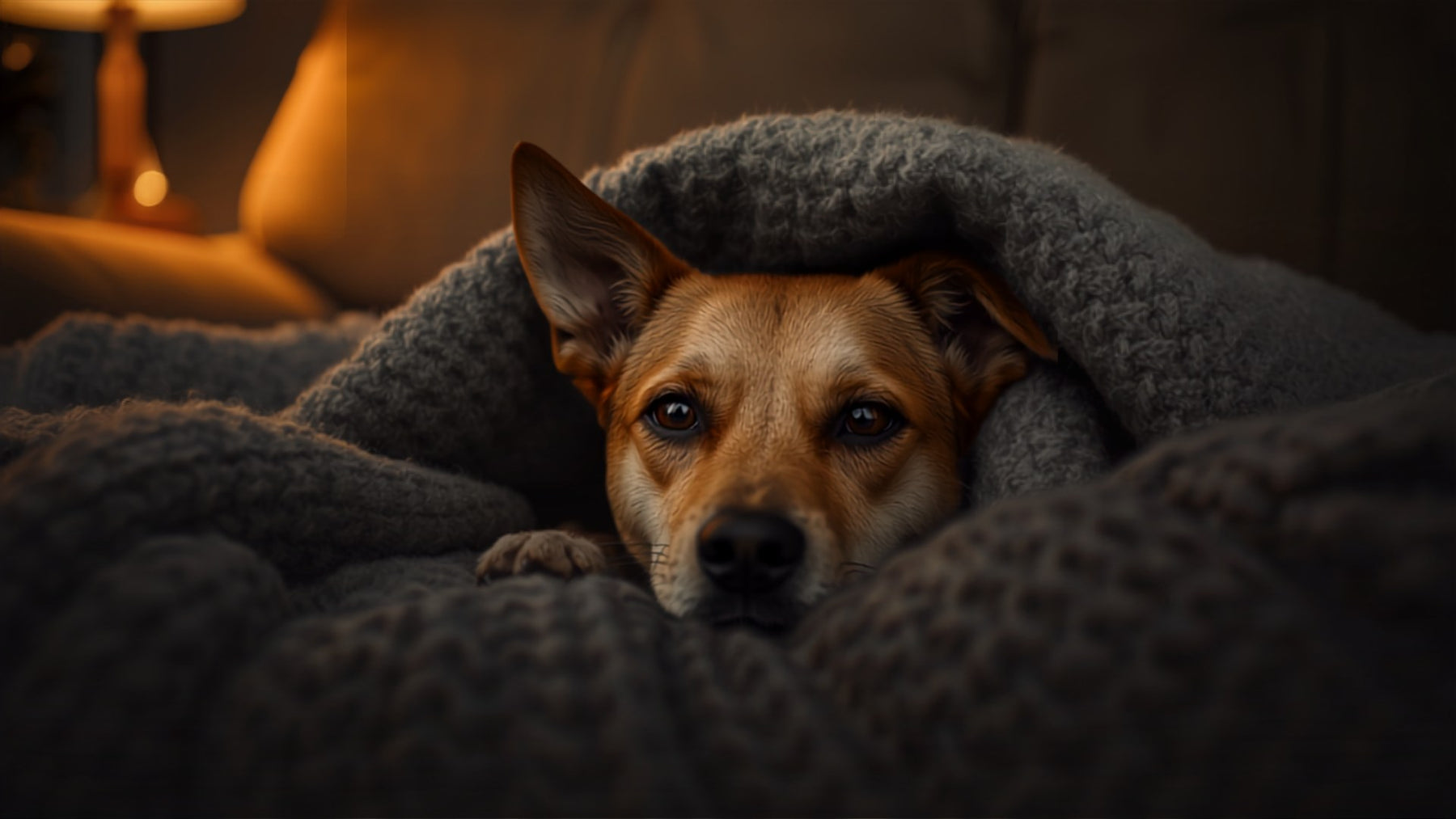
It usually starts on the afternoon of 31 December. A distant bang, and your dog, who was lying relaxed on the sofa a moment ago, is standing wide-eyed in the hallway. Until midnight, they will pant, tremble, hide under the bed or scratch at the door. And you sit beside them, feeling just as helpless as they do.
The same pattern repeats itself every year in thousands of homes at once. A dog may tremble through three New Year’s Eves before anyone realises that the real help lies not in the night itself but in the weeks beforehand. That is exactly what this article is about.
Why fear of fireworks is so persistent
For a dog, a bang is not a noise but an attack out of nowhere. They cannot see, smell or make sense of its source. Their brain switches into survival mode, and in that mode they do not learn, they simply store one message: that was dangerous. Every New Year’s Eve reinforces this memory. In many dogs, the fear therefore tends to grow stronger over the years if nothing is done.
Worth knowing: fear is not a training issue. You cannot command it away. Nor can you reinforce it by comforting your dog. That myth has already left far too many dogs alone in the bathroom.
What helps in the weeks beforehand
Tiny doses of noise
It is best to start early, if possible months beforehand (British animal welfare organisations such as the RSPCA advise preparing in good time and seeking veterinary or behavioural-therapy help if the fear is strong) and to play fireworks sounds. Very quietly, so quietly that your dog at most briefly turns an ear. Meanwhile something pleasant happens: eating, playing, chewing. Over weeks, the volume slowly rises. As soon as your dog becomes restless, you are going too fast: lower the volume at once and take a break. The whole approach is called counterconditioning and is among the things specialists recommend for long-term preparation. How long it takes differs from dog to dog. If the fear is strong, it is best to plan this together with your vet practice or a vet with an additional qualification in behavioural therapy, who sets the volume, stress signs and stopping points with you.
Training is one building block, not a guarantee, and how quickly it works differs from dog to dog. Stop practising right away if your dog pants, trembles, hides or stops eating, and carry on later at a much lower volume.
A safe place
Your dog needs somewhere they already feel comfortable beforehand: a den made from blankets, a crate with the door open, an internal bathroom. Set it up in December and make it the best place in the home, with chews and peace and quiet. On New Year’s Eve, it is then not a last resort but home.
There is no shame in asking the vet
For strong fear, there are medications that can help many dogs without sedating them. Raise it in November, not on 30 December. And be careful with products that merely keep a dog still: the dog may then seem relaxed but can still feel the fear. Which product is suitable is therefore a matter for the vet practice.
Whether a medication is an option, and which one, is decided by the vet practice after an examination. A reliable effect cannot be promised.
What really helps on the night
- A long walk in daylight, as early in the day as possible, to tire them out and empty their bladder. Keep them on the lead as soon as fireworks are likely, so also during the day and on the days before and after New Year’s Eve, in the garden too. Every year, dogs run away in panic. So also make sure your dog is microchipped and registered with up-to-date contact details.
- Windows shut, blinds down, music or TV on. Not loud, but constant. An even background sound muffles the bangs.
- Stay with them if you can. For an anxious dog, a trusted person is often the greatest help on this night.
- Comforting is allowed. If they seek closeness, give it to them. Stroke them calmly, talk calmly. If they want to hide, let them, but stay close.
- Chewing and licking are calming. A lick mat with quark, a filled Kong. Many dogs are too scared to eat, but if yours can, it helps.
- No drama on your part. You may worry, but do it quietly. Many dogs clearly pick up on our tension.
What only sounds reassuring
With Thundershirts, some owners report a little more calm, while in other dogs no difference shows. Bach flower remedies have been tested repeatedly in controlled studies in humans, and none of these studies showed an effect beyond placebo; for dogs there are no reliable data at all (Ernst, Swiss Medical Weekly 2010; Thaler et al., BMC Complementary and Alternative Medicine 2009). Plug-in pheromone diffusers can help some dogs feel a little more relaxed, but they do not replace training. And as for the classic approach of shutting the dog alone in the bathroom so that they calm down: that is often not calm but resignation. They stop resisting, and the fear remains.
After New Year’s Eve
The world is not back to normal on 1 January. Many dogs remain jumpy for days. Take the first walks somewhere nobody is setting off leftover fireworks, and give them quiet days and plenty of sleep. And start early for next year. With good training, the fear becomes smaller in many dogs, but nobody can promise that.
A personal thought
Few moments show as clearly as New Year’s Eve how much our dogs trust us. They cannot understand what is happening, but they look to us. Anyone who has held a trembling dog in their arms who slowly settles because they sense their human is there knows what this relationship is about. Not commands. Dependability.

It is exactly this look that stays with you in a portrait: the one they search for you with on the loudest night of the year. Dog portraits are available on canvas, in wooden frames, on acrylic glass and as posters.
New sounds are easiest for a dog to handle when they get to know them calmly as a puppy. For this, our free Puppy Starter Pack includes a socialisation bingo with 50 experiences.
Further reading
- Teaching your dog to be alone: because fear and being alone often go together
- Older dog, new rules: older dogs are more sensitive
- Puppy training: the 5 rules: foundations you can build beforehand
Sources on the effectiveness of Bach flower remedies, accessed on 19.09.2026: E. Ernst, “Bach flower remedies: a systematic review of randomised clinical trials”, Swiss Medical Weekly 2010, and K. Thaler et al., “Bach Flower Remedies for psychological problems and pain: a systematic review”, BMC Complementary and Alternative Medicine 2009 (both via PubMed). Both papers examine studies in humans. There are hardly any data on dogs: a small Korean study (Y.-S. Seo, Journal of Environmental Science International 33(8), 2024, https://journal.kenss.or.kr/xml/41615/41615.pdf) compared Rescue Remedy with water in 12 dogs during nail trimming. It does not examine fear of fireworks and reports neither random allocation nor blinding. It is therefore not evidence that Bach flower remedies work against New Year’s Eve fear.


