

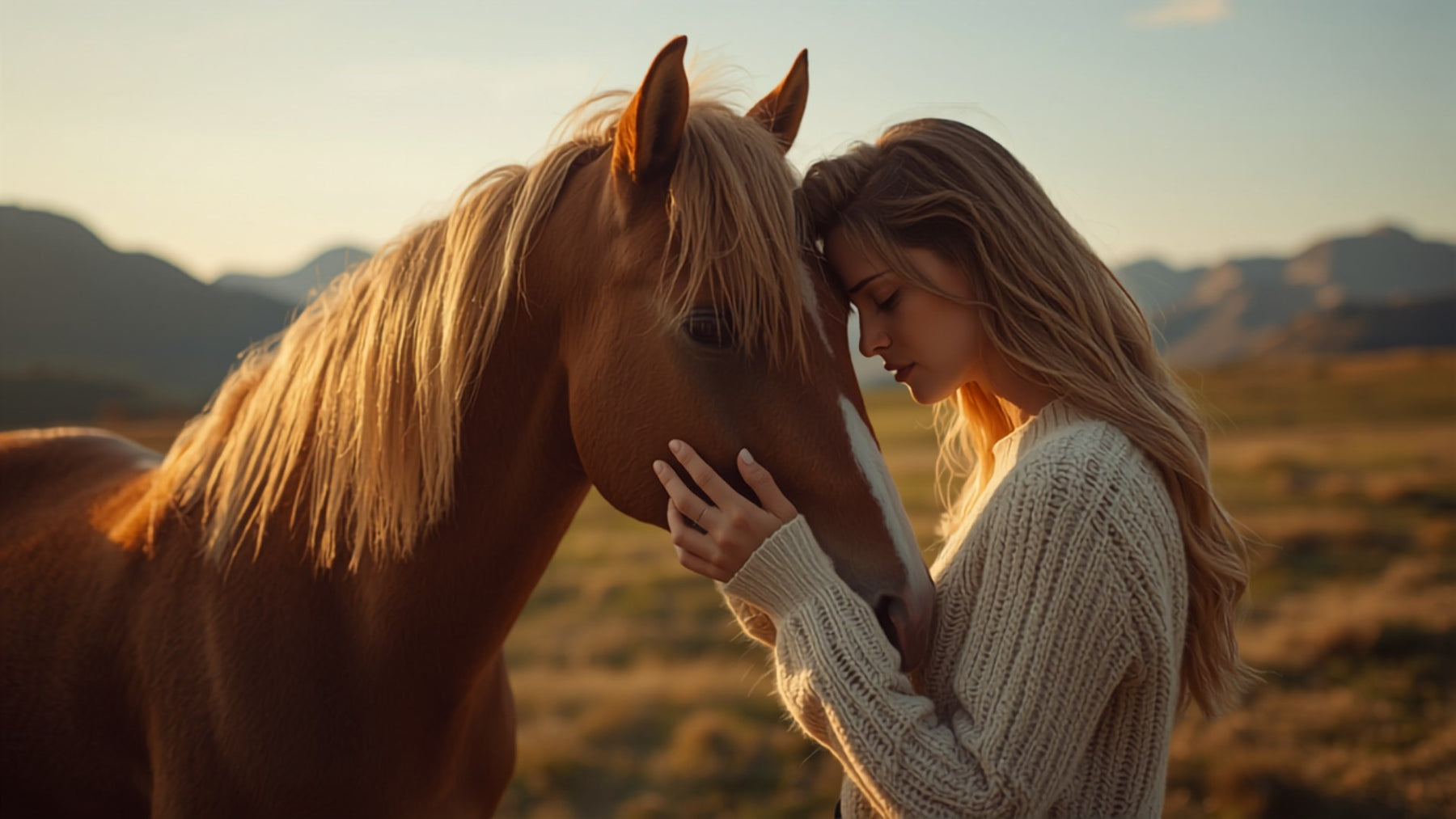
Anyone who has ever seen a Haflinger trotting across a mountain meadow with its blond mane flowing understands why this breed accompanies so many people for a lifetime. The Haflinger is above all a versatile leisure and family horse, not a status symbol. Competitions are still possible: there are even dedicated Haflinger European Championships with dressage, show jumping, driving and western. It is a horse for people who want to ride without constantly fighting, and who are looking for an animal that thinks along with them.
But Haflingers also have a reputation, and half of it is deserved: stubborn, greedy and laid-back. Let us take an honest look.
The Haflinger at a glance
- Origin: South Tyrol and North Tyrol, named after the village of Hafling near Merano
- Height at the withers: 138 to 150 cm, officially making it a small horse
- Weight: 400 to 550 kg
- Colour: Always chestnut, from pale gold to dark liver chestnut, with a light mane and tail
- Life expectancy: 25 to 30 years, with many living longer
- Temperament: Steady-nerved, people-oriented, willing to learn, independent
Temperament: the mind is the best part
Haflingers were bred as mountain working horses. They had to carry loads along narrow paths where one wrong step could be fatal. That left two lasting qualities: they are sure-footed and calm, and they make their own decisions. People who do not understand the latter call it stubbornness.
A Haflinger that stops usually has a reason. It sees something, does not understand the aid or has learnt that stopping works. Treat it as a battle and you lose. Treat it as a conversation and you have a horse that stays with you through thick and thin. That is precisely why Haflingers are so popular with children and beginners: they forgive mistakes without bolting.
Five things that determine their health
1. They gain weight on next to nothing
The Haflinger is a good doer, bred for sparse mountain pastures. On lush German grazing it puts on weight within a few weeks, and in this breed excess weight is the direct route to laminitis and Equine Metabolic Syndrome. In concrete terms: limit grazing time, especially strictly in spring, weigh the hay, no hard feed except for genuine work, consider a grazing muzzle. If you can't stick to that, you will end up with a sick horse. This is the most important point in this entire article.
2. Not a horse for large adults?
With its powerful body and short back, a Haflinger can carry many adults, but not everyone and not every Haflinger. As a rough guide, 15 to 20 per cent of the horse's weight applies to rider and saddle together, so with 500 kg that is 75 to 100 kilos. This is a guideline, not a green light: what your horse can really cope with depends on build, fitness and feeding condition, age, a well-fitting saddle and your riding ability, and may be considerably lower. If you are unsure, have the horse, saddle and you assessed together by a vet, saddler or riding instructor.
3. Athletic, but not in every discipline
Haflingers are excellent trekking and endurance horses, reliable driving horses and to be taken seriously in dressage: at the Haflinger European Championship, dressage tests are held up to M level and show jumping courses up to 1.10 metres. How far an individual horse gets depends on build, training and rider. If you have ambitions in top-level sport, you should honestly check this beforehand.
4. The hooves are tough; the rest is not
The hooves are usually excellent, and many Haflingers go barefoot for life. The breed is, however, prone to sweet itch and mud fever in the thick feathering when turnout is muddy. If you love the breed for its mane, you also need to care for it: that light mane mats, tangles and becomes discoloured without regular brushing.
5. They need tasks
A bored Haflinger becomes creative, opening doors, field-gate catches and feed rooms. They need variety, hacking, groundwork and tasks that let them think. Endless circles in an arena dull the mind.
Care: what they need
- A group in an open stable or paddock. Haflingers are social and hardy; stabling without daily turnout does not meet this breed’s needs.
- Controlled feeding. See above. Hay nets, a grazing muzzle and weighed portions. That is love, not stinginess.
- Exercise. Work or extended turnout that encourages movement at least five days a week.
- Regular checks. Body condition score every four weeks, blood tests once a year to check metabolism.
What does a Haflinger really cost?
The purchase price is the smallest item. A healthy, well-schooled leisure horse today usually costs 5.000 to 10.000 euros, foals from around 2.500 euros and competition horses considerably more. Allow a further one-off 1.500 to 3.000 euros for a saddle, bridle, rugs, grooming kit and pre-purchase examination.
Realistic ongoing costs are 450 to 900 euros a month, and over 1.000 euros near cities. Here is the breakdown:
- Livery: 200 to 350 euros in an open stable, 350 to 700 euros for a stable with turnout, more in urban areas
- Farrier or hoof trimmer: every 6 to 8 weeks, 40 to 60 euros barefoot, 100 to 180 euros shod
- Routine veterinary care: vaccinations, worming and dental checks, equivalent to 40 to 80 euros a month, excluding emergencies
- Insurance: liability cover 10 to 25 euros, surgery cover 30 to 90 euros a month, strongly recommended for Haflingers because of laminitis risk
- Feed and extras: hay is usually included in livery; mineral feed and grazing muzzle 20 to 40 euros
- Riding lessons, equipment replacement, trailer or travel: 50 to 200 euros depending on expectations
Then comes the day something happens: colic surgery costs 5.000 to 10.000 euros, and months of laminitis treatment quickly reach 1.500 euros or more. If you have neither a reserve of at least 3.000 euros nor surgery insurance, wait before buying a horse. That is not spoiling the fun; it is the difference between a horse that grows old and one you cannot save in a crisis.
Who is a Haflinger right for?
Families wanting a horse that carries children and adults alike. Leisure and trail riders. People who see a horse as a partner. Not competition riders aiming for German class S, or people who cannot cope with a no.
Frequently asked questions
Are Haflingers really stubborn? They are independent. Communicate clearly and fairly, and you do not have a stubborn horse.
Is a Haflinger cheaper to keep than a warmblood? A little: they eat less, often go barefoot and are hardy. But livery, vet care and insurance cost the same as for any other horse.
How long can you ride a Haflinger? With good care, often well into old age. Seeing 25-year-old Haflingers out hacking is not unusual.
A golden chestnut in front of the camera
The golden colour and light mane make the Haflinger perhaps the loveliest horse subject for watercolour. Photograph in late-afternoon backlight, when the mane glows, from slightly in front with the ears up. Rustle a treat in your pocket and you have that expression.

The best Haflinger photo usually sits in a stable folder and is never looked at again. As a poster above a desk or a canvas in the living room, you see it every day. Find the available formats in our horse portraits.
Find name ideas for your Haflinger in our horse name finder.
For young horse fans, we have our Pferde Malbuch für Kinder with 44 horses, ponies and foals. You can find it on our books page (book in German).
Further reading
- Buying a horse: the honest checklist: before things get serious
- Photographing horses: keeping chestnut coats from blowing out in a photo
- Giving a pet portrait: what goes on the wall afterwards


