

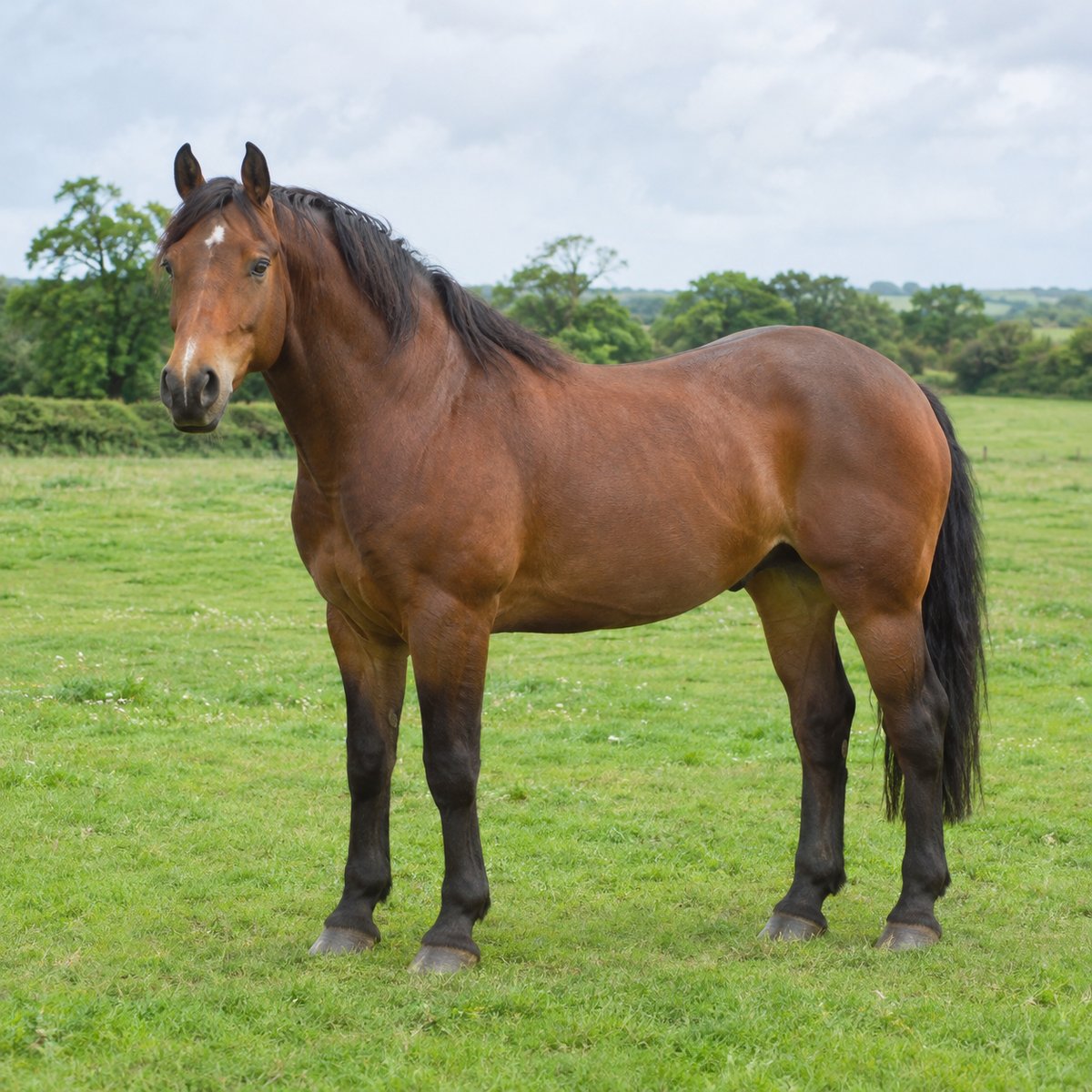
In the morning in front of the plow, in the afternoon in front of the car into town and at the weekend behind the pack over ramparts and ditches: the Irish Draught was bred for this life. He is not a cold blood, even if the name sounds like it. He is a strong, strong-nerved riding horse with lots of bones that feels at home on wet, uneven ground.
| Type | Warmblood, strong riding and all-purpose horse |
|---|---|
| Origin | Ireland |
| Breeding association | Irish Draft Horse Society in Ireland (founded 1976); other companies, among others in Great Britain, Canada and North America |
| Stock size | according to the breed standard of the North American society, ideally 158 to a maximum of 170 cm |
| Colors | any strong basic color, such as brown, gray, chestnut, black and dun; a lot of white is undesirable |
| Usage | Leisure, hunting, jumping, eventing, driving; Crossing partner for sport horses |
Origin and History
Irish Draughts have been documented in writing since the late 18th century, according to The Livestock Conservancy. Small Celtic horses, Norman horses and later Connemara ponies, Spanish horses and thoroughbreds probably have their roots. Heavy, heavily hung cold-blooded horses had difficulty coping with the Irish soil; a lighter but equally strong horse was needed.
In 1901 the breed was officially recognized. The first stud book from 1917 was lost in a fire. The stock collapsed with tractors and cars. What saved the Irish Draft was its role as a cross-breeding partner: Irish Hunter and Irish Sport Horses were created when crossed with thoroughbreds. However, this has further thinned out the purebred population. The Irish Draft Horse Society was founded in 1976 to promote pure breeding.
Conformation
The standard of North American society describes a versatile, powerful and athletic horse with substance and quality. A height of 158 to 170 cm and a cannon circumference of around 23 cm are ideal. Typical features are a friendly head without a rough profile, short cannon legs, well-arched ribs, a strong kidney area and a strong hindquarters with a wide stride. Any strong basic color is permitted; a lot of white is undesirable. The Livestock Conservancy even calls white on the legs above the forefoot or hock a defect.
Character (interior)
The standard emphasizes a good temperament, calmness and a willing character, as well as a robust constitution. This fits with what many riders appreciate about him: he stays calm in the terrain when other horses are already prancing and jumps honestly when he has understood the obstacle. But calm doesn't mean blunt. An Irish Draft wants to be challenged, otherwise he tends to become stubborn.
Keeping and feeding
A horse that used to get by on what an Irish farm provided rarely needs high-energy concentrated feed today. Many Irish Drafts maintain their weight on good hay and pasture. However, horses that are easy to feed are particularly prone to obesity and equine metabolic syndrome, which promotes laminitis (University of Kentucky). Therefore, plan hay according to weight, a pasture with a sense of proportion and real exercise every day. Open stable or paddock with a group suits his nature better than spending many hours in the box.
Health
We have not found any reliable published data on hereditary diseases typical of the Irish Draft breed. The standard describes the breed as naturally healthy. As with any large, heavy riding horse, hooves, joints and back should be checked regularly and a thorough veterinary examination should be carried out before purchase.
Who is the Irish Draft suitable for?
For recreational riders who are looking for a reliable, strong horse for cross-country, hunting and amateur jumping. He suits people who like to be outdoors and appreciate a horse that thinks for themselves. Even larger and heavier riders are in good hands with him.
For whom not?
If you are looking for a fine, very elastic dressage horse for competition, you will be happier with other breeds. According to The Livestock Conservancy, comparatively few purebred Irish drafts are bred. Allow time for the search and check the papers carefully if purebredness is important to you.
Furthermore: You can calculate how much a horse really costs per month with our Horse Cost Calculator, and before you buy the Horse Buying Checklist will help you. You can find ideas for the stable name in our horse names, and your own horse is available as a horse portrait from your own photo. All breeds at a glance: Horse breeds from A to Z.
Frequently asked questions
How tall is an Irish Draft? The standard of the North American Irish Draft Society calls for an ideal height of 158 cm to a maximum of 170 cm.
Is the Irish Draft a coldblood? No. Despite the name, he is considered a warmblood, i.e. a strong riding and all-purpose horse without heavy riding.
Is an Irish Draft suitable for beginners? Its calm, willing nature makes it a good partner even for less experienced riders, if training and support are right.
What is the difference between Irish Draft and Irish Sport Horse? The Irish Sport Horse is usually created by crossing Irish Draft and Thoroughbred. The Irish Draft itself is the purebred basis.
Read more
Quellen, abgerufen am 05.11.2026: Irish Draught Horse Society of North America: Registration Policies und Breed Standard; The Livestock Conservancy: Irish Draught; University of Kentucky Cooperative Extension: Equine Metabolic Syndrome, Is My Horse Just Fat or Is He Sick? (ID-239).


