

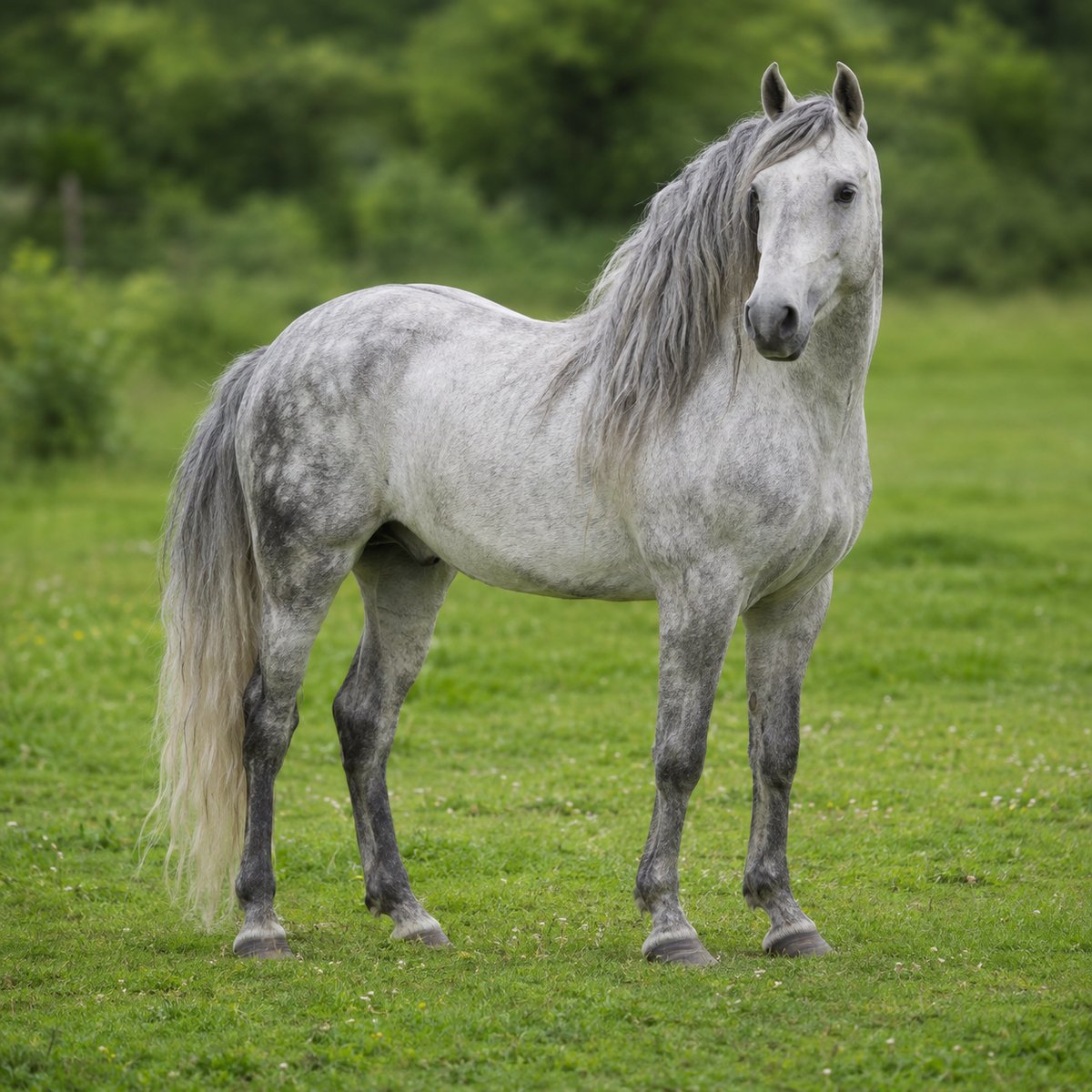
In his homeland, the Berber is still ridden in Fantasia, a traditional equestrian game, and for hunting. With us you tend to meet him on trail rides: a compact horse with a long mane, low-set tail and small, hard hooves. He is bred for frugality and strong nerves.
| Type | North African type riding horse |
|---|---|
| Origin | Algeria, Morocco, Tunisia |
| Breeding association in Germany | Branch book at the Rheinisches Pferdestammbuch e.V.; Original studbook at the Mondiale du Cheval Barbe (OMCB) organization in Algiers |
| Stock size according to breeding program | approx. 148 to 158 cm |
| Colors | all |
| Usage | Distance, cross-country and trail rides, light carriage, depending on the model, classic, western or sport dressage |
Origin and history
The Berber comes from the North African coast, the Maghreb. During Moorish rule on the Iberian Peninsula from the 8th to the 15th centuries, horses were repeatedly exchanged between North Africa and Spain, writes Mad Barn; Berber blood also flowed into Spanish horses. Later, Arab-Berber crosses partially displaced the pure Berber in its homeland, and from 1965 onwards African horse sickness decimated the population. Mad Barn names around 5,500 North African Berbers in the Maghreb today.
The original breeding book is kept by the OMCB based in Algiers. The Rhenish Horse Stud Book maintains a branch studbook for Germany and Belgium; At the beginning of 2024, 32 mares and 14 stallions were registered there.
Exterior
The breeding program describes a fairly strong, noble, dry head with a straight to slightly convex profile and almond-shaped eyes, an elegant, rather broad neck with a long mane and a square, upright body with a short back and sloping croup. The tail is set low and full. The hooves are small and hard, pasterns are not desirable, and the cannon bone circumference should be at least 18 cm. The height is between 148 and 158 cm; all colors are permitted.
Cross-bred Arabians are possible as part of the breeding program, but the Berber portion should prevail.
Character (interior)
According to the Rhenish Horse Stud Book, what is bred is a frugal, persistent, sociable and good-natured horse with a friendly nature, strong nerves, balanced, courageous and intelligent and very people-oriented by nature. That sounds like a wish list, but it describes what is actually taken into account when selecting breeding: Interior is a separate selection characteristic in addition to health.
Keeping and feeding
Frugality is part of the breeding goal. Mad Barn cites obesity, metabolic disorders and laminitis among the breed's health issues. For everyday life this means: good hay, mineral feed and lots of exercise instead of fat pasture and plenty of concentrated feed. An open stable with a group and space to run is better than an individual box.
Health
The Berber is considered a relatively healthy breed, according to Mad Barn. A study in the Middle East and North Africa that Mad Barn cites found differences between Arabians, Arabian-Berbers and Berbers: Pure Berbers do not appear to carry the inherited diseases of Arabians, but Cerebellar Abiotrophy (CA) and SCID can occur in horses with Arabian components. If your Berber has Arab ancestry, ask about genetic tests on the parents.
Mad Barn mentions osteochondrosis, stomach ulcers and joint wear as other topics. The breeding program also expressly selects for health and interior.
Who is the Berber suitable for?
For hiking and endurance riders who are looking for a durable, sure-footed horse, and for people who want a people-oriented, strong-nerved leisure horse. Depending on the model, it is also fun in classic dressage or western riding.
Who is it not for?
For riders who are looking for a large sport horse with a long canter for jumping or tournament dressage. And for everyone who would have to keep an easy-feeding type in a rich pasture.
Continuing: Before you commit, go through the checklist for buying a horse and use the Horse Cost Calculator to find out what the stable, feed, farrier and vet cost per month. For the name there is our horse name, for the wall there is a horse portrait from your own photo. You can find more breeds in the overview Horse breeds from A to Z.
Frequently asked questions
How tall does a Berber get? The breeding program states a height of approx. 148 to 158 cm.
Where does the Berber horse come from? From North Africa, Algeria, Morocco and Tunisia. The original breeding book is kept by the OMCB in Algiers.
Is a Berber an Arab? No. Berbers and Arabs are separate races. In the breeding program, Arabians are possible as cross-crosses, but the Berber proportion should predominate.
What is a Berber suitable for? For endurance, cross-country and hiking rides, light carriage and, depending on the model, for classical, western or sport dressage.
Read more
Quellen, abgerufen am 05.11.2026: Rheinisches Pferdestammbuch e.V.: Zuchtprogramm Berberpferd (Stand 02/2025); Mad Barn: Barb Horse Breed Profile.


