

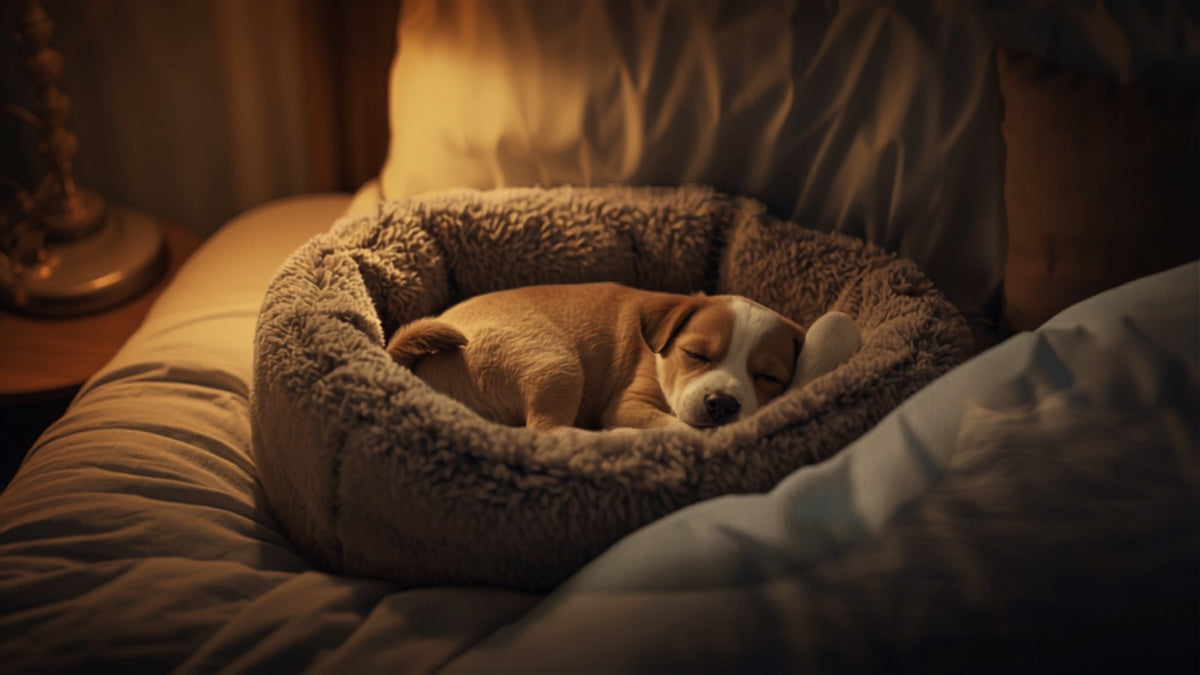
He cries as soon as the light goes out and won't stop. That is normal on the first night and has nothing to do with spoiling him: for the first time in his life, your puppy has no siblings, no mother and no familiar scent around him. What helps now is closeness, not consistency. A sleeping spot right next to your bed, a T-shirt you've worn and calm, short trips outside to relieve himself settle most puppies within a few nights. Letting him cry it out, on the other hand, achieves nothing except robbing both of you of sleep.
The video
Clicking loads the video from YouTube. Data is transferred to YouTube (Google) in the process. Privacy policy
Why he cries: panic, not defiance
A puppy of eight to ten weeks has known nothing but life in a litter until this evening: warm bodies on the left and right, constant noise, never truly alone. And now he is lying in an unfamiliar room that smells strange and sounds strange, and the familiar bodies are gone. The crying is not a demand and not a test of whether you will give in. It is real separation anxiety, built in biologically just as it is in a human toddler. If you read it as defiance and consistently ignore it, you mostly just extend the time it takes the puppy to settle, because fear that nobody answers doesn't get smaller, it sets in.
On top of that, the puppy has no concept yet that you will be back tomorrow. To him, a closed door isn't a “see you in a bit” but a “forever”. That is exactly why physical closeness works so much more strongly in the first nights than any training principle that may become useful later. Only once he has learned that being alone ends safely can he also learn to cope with short separations.
Preparing in the evening
The first night gets easier if you prepare for it instead of improvising. Four things make the biggest difference:
- The sleeping place is next to your bed, not in the hallway or the kitchen. The puppy should be able to hear and smell you without seeing you.
- A T-shirt you have worn lies in the crate or the basket. It costs nothing and gives him a familiar smell that helps many puppies fall asleep.
- A hot water bottle wrapped in a towel replaces the body warmth of the littermates. Not too hot, lukewarm is enough.
- The last toilet trip is shortly before bedtime, after that only rest, no more exciting play.
Deliberately skip visitors this evening. As lovely as it is to show off the new puppy, every extra stimulus makes the transition into the night harder, not easier. What else is coming up in the first few days and what needs to be in the house beforehand is covered in Puppy checklist: essentials and the first 3 days.
How the night goes, hour by hour
In the first hour after lights out he will almost always cry, sometimes only briefly, sometimes for quite a while. Let one hand hang down from the bed so he can smell you, and talk as little as possible. If he does not calm down within a few minutes, or you have the impression he needs to relieve himself, take him outside. Without talking, without play and with only as much light as you need to get there safely: out, business, straight back in. Anything else signals to him that staying awake is worth it.
Between midnight and the early morning hours is usually the quietest phase, provided the last trip outside was shortly before sleep. If he wakes up in between and whines briefly, wait a moment before you react. Often he falls asleep again on his own. If the whining gets louder and keeps going, that is a signal from the bladder, not a reason to worry. At eight weeks a puppy holds on for about two hours while asleep, at three months for about three.
Towards early morning, usually between five and seven o'clock, he wakes up for good and wants to go out and eat. That is not a bad habit but the natural rhythm of a puppy stomach and a puppy bladder that don't hold much yet.
What makes it worse
The advice to “just let him cry so he learns” persists stubbornly, but it is outdated and, for a puppy in the first nights, simply a misunderstanding. Ignored crying in such a young animal doesn't turn into calm, it turns into more stress, which shows up in the following nights. The opposite doesn't help either: picking the puppy up at night, playing with him or taking him into your own bed when he really only needed to relieve himself. He quickly learns that crying leads to attention and fun, and that is exactly what makes the next nights longer, not shorter. What helps most is consistency in your reaction: out when he needs to go, quiet when he is just unsure, and the same strategy every night, not a new one each evening.
When it gets better
After the first two to three nights, the crying noticeably eases in most puppies. After about a week, many sleep through with just one short break to relieve themselves, which, depending on age, stays for a few more weeks. What matters here is comparing with your own puppy of yesterday, not with other people's success stories from the internet: some puppies need two nights, others two weeks, and both are within the normal range as long as you can see a trend toward the better.
A short setback is also normal, for example after an exciting day, a visit to the vet or when the teeth are changing. That doesn't mean you are back to square one, only that one night is harder than the last three. Stick with the same strategy instead of trying something new with every setback.
When the nights get calmer and the bladder moves into the foreground, House-training your puppy is the next read. And the weekly plan for the whole first month is in The first 30 days with a puppy.
When to call the vet
A little crying and restlessness on the first night are normal. It looks different if the puppy screams continuously instead of whining, if vomiting, diarrhea or conspicuous listlessness are added, or if he doesn't settle at all even after several nights and seems apathetic during the day. Those can be signs of pain or a health cause that has nothing to do with separation anxiety. This article does not replace veterinary advice. When in doubt, it is better to call the vet's practice once too early than to wait for days.

When these nights are over, there is often exactly one picture missing from that time. The puppy who didn't want to sleep looks better on acrylic glass or as a poster than in your phone gallery. You see the preview before anything is printed.
The complete starter pack, free of charge
Everything important from the first thirty days on 58 printable pages: the honest shopping list, the first 72 hours hour by hour, a 4-week plan, a socialization bingo with 50 experiences and the emergency page for the fridge.
The first 30 days, download here for free
If you want to build up sleeping and staying alone beyond the first nights, you will find the way there in Welpenerziehung & Junghundtraining.
Keep reading
- Puppy checklist: essentials and the first 3 days: what should be in the house before this night
- House-training your puppy: the topic that shapes the nights afterwards
- Teaching your dog to be alone: what the first night turns into, step by step
Source for bladder capacity: American Kennel Club, How to Potty Train a Puppy. Accessed on 19.09.2026.
The links to our books are affiliate links. If you buy through them, you support us at no extra cost to you.


