

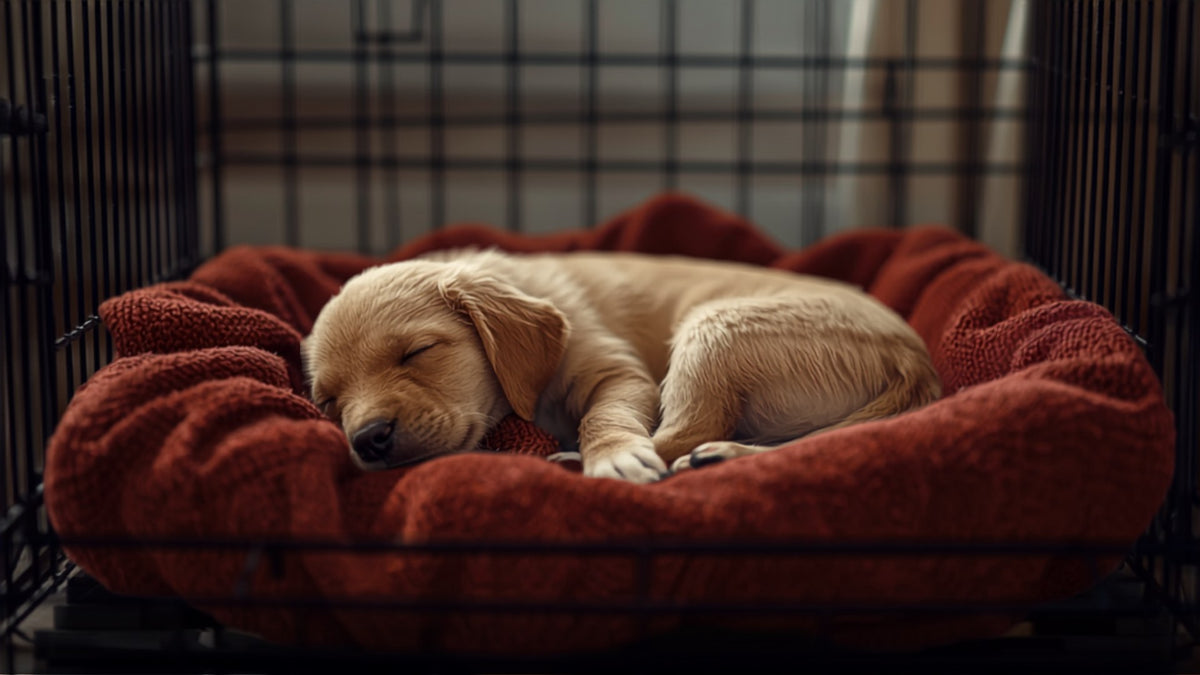
The day your puppy comes home is one you never forget. That little nose at the car window, the first uncertain steps in the hallway, the first time they curl against your foot and fall asleep. Then, around 23:00, the first whimper in the dark. Welcome to the family.
The video
Clicking loads the video from YouTube. Data is transferred to YouTube (Google) in the process. Privacy policy
Three questions almost always come first: what do I really need? What should I do during the first nights? And why is the puppy so strangely quiet on day two? Here are the answers, based on what works rather than an ideal picture.
Before arrival: what you really need at home
The pet shop will tell you that you need everything. You need surprisingly little, but it must be the right things:
- A retreat: an open crate or a bed in a quiet corner. Away from thoroughfares and the television. The puppy should be able to see the room without being in the middle of it.
- Familiar food: ask the breeder or shelter what the puppy has been eating and continue it for at least two weeks. Changing food and moving home together is a reliable recipe for diarrhoea.
- A harness rather than a collar: a soft, adjustable puppy-sized harness. An uncertain puppy can quickly pull against their own windpipe on a collar. A collar can be added later for an identification tag and address, but should not be pulled on.
- A light lead, 2 to 3 metres: no retractable lead. In the first days, you want closeness rather than distance.
- Two bowls, a chew and a soft toy: ideally leave the toy with the breeder a few days beforehand so it smells of the littermates.
- Kitchen roll and enzymatic cleaner: avoid vinegar cleaner. Enzymatic cleaner removes the smell so the spot does not become a regular toilet.
What you do not need: mountains of toys, a 120-euro puppy bed or a camera notifying you every three minutes. Those can come later, or never.
Day 1: settling in rather than training
The most important sentence for the first day: nothing is happening today. No visitors, no introductions to the neighbours, no training. The puppy has just lost their mother, siblings and everything familiar. They are overwhelmed, rather than excited.
Immediately on arrival, show the puppy the garden or the spot for toileting. Praise calmly if they use it. Then go inside, provide water, show the retreat and leave them in peace. Sit on the floor, read a book and be there. The puppy decides when to seek contact. Almost all do so within an hour.
For the first night, there is one rule: crate or bed beside your own bed, rather than in the kitchen or hallway. If the puppy whimpers, lower a hand, speak quietly and leave the light off. If they need to go out, accompany them without talking, then return straight to bed. Everything else, from the evening routine to an hour-by-hour breakdown, is in Puppy will not sleep: what really helps on the first night.
Day 2: the quiet day
Many puppies are calmer on the second day than on the first: they eat a little less, play less and sleep a lot. Moving is exhausting, and lots of sleep is normal at this age. Let him sleep. What matters is the difference between tired and sick: if he eats nothing at all, vomits, has diarrhoea or seems listless even when awake, call your vet the same day. An eight-week-old puppy needs 18 to 20 hours of sleep a day, and an overtired puppy is a biting, whining, unmanageable puppy.
Don't wait several days with these signs. Whether a puppy is exhausted or ill is for the vet practice to judge, not a dog trainer.
Day 2 is about routine: outside after every sleep, meal and play session. Always the same spot and the same quiet cue. Accidents happen indoors, and that is fine. No scolding and no rubbing their nose in it. Wipe up, use enzymatic cleaner and carry on. The full routine is in Housetraining your puppy.
A short outing is fine: five minutes outside the front door, carried or on a lead, simply watching. Cars, people, sounds. Watch rather than approaching everything. This is the beginning of socialisation: observing rather than touching.
Day 3: the first rules, quietly
A little everyday life can begin now. The puppy knows their bed, toilet spot and your voice. Three things are already worthwhile on day three:
- Their name. Say it when the puppy looks at you and give a piece of food. Avoid calling it ten times in succession, which only teaches them it is background noise.
- Tiny doses of being alone. Go into the next room, leave the door ajar, wait 30 seconds and return without fuss. This lays the foundation for being relaxed alone later.
- Bite inhibition. Puppy teeth are needles. If they nip too hard, give a short, high-pitched “Ow”, like a littermate’s squeak, and pause play for 10 to 20 seconds. No grabbing the muzzle or shouting. The complete process and every stage are in Puppy biting: teaching bite inhibition.
And no, the puppy does not need to know “sit” on day 3. They need to know you are predictable.

You forget what happens in these three days faster than you expect. The “Our First Year” Dog Journal (book in German) has space for the first night, first photo and first outing.
The five mistakes almost everyone makes
- Too many visitors. Everyone wants to see the puppy. Ask them to wait until week two.
- Walks that are too long. A common rule of thumb is five minutes per month of age, twice daily. No study establishes that exact figure; it comes from breeder and trainer practice. The general direction is still right: a ten-week-old puppy should not go hiking, and open growth plates are a real reason for that.
- Ignoring them at night. A puppy howling alone at night learns that nobody comes, rather than independence.
- Punishing accidents. The puppy does not understand the connection. They only learn to hide from you when toileting.
- A new place every day. Puppy class, the DIY shop, a café, Grandma’s. Two new experiences per day are plenty.
What to preserve from these days
Take photos. Real ones rather than perfect ones: the puppy asleep in the bowl, the uneven ears, that first look suggesting they already know you are their person. In three years, these pictures will be worth more than any toy you buy today.
Photos from the first weeks are often the only ones later showing your dog still small. Keep them at full resolution rather than only as WhatsApp copies. For a photo suitable for a later portrait, aim for daylight, eye level and a sharp face. Find more in our article about dog photos.
A puppy photo ages faster than any other picture in the house. If you want one on the wall, you see the preview first. We print only when you are happy.
At a glance
- Day 1: allow settling in, show the toilet spot and put the bed beside yours.
- Day 2: plenty of sleep, a toileting routine and five minutes watching the world.
- Day 3: name, seconds of being alone and bite inhibition.
- No visitors, long walks or punishment.
If something goes wrong, that is normal. Puppies do not read checklists. They read you.
The complete Puppy Starter Pack, free
Everything important for the first thirty days in 58 printable pages: an honest shopping list, the first 72 hours broken down hour by hour, a 4-week plan, socialisation bingo with 50 experiences and the emergency page for the fridge.
The First 30 Days: download free here
Prefer holding a book? Puppy Education & Adolescent Dog Training (book in German) covers the same foundations in detail, right through adolescence.
To go with it: a food bowl with your dog’s name, made from stainless steel with a decorative band.
Still choosing a name? Try our dog name finder. If the breed decision is still open, try our honest breed quiz.
Further reading
- The first 30 days with a puppy: the monthly plan these three days belong to
- Housetraining your puppy: where most owners struggle
- Puppy training: the 5 rules: the principles behind everyday life
- 170+ dog name ideas: if you are still choosing a name
Source on bite inhibition: ASPCA, Mouthing, Nipping and Play Biting. Accessed on 19.09.2026.
Links to our books are affiliate links. Buying through them supports us at no extra cost to you.


