

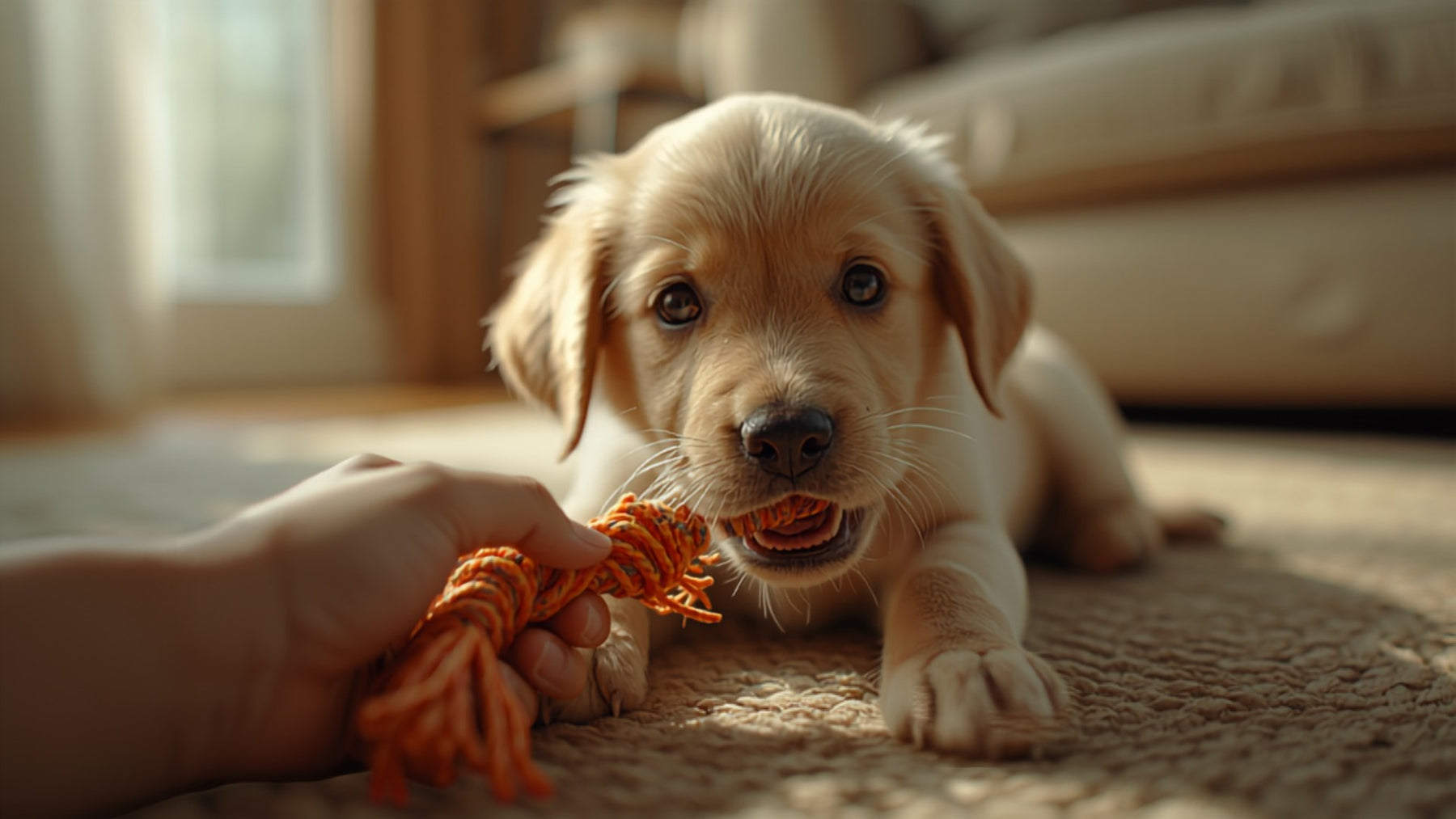
In the third week with a puppy, a lot of forearms look as if their owner has wrestled a cat. The puppy jumps, snaps, hangs off your trousers, nips at your calf and thinks it is all wonderful. That is not a sign of an aggressive dog. It is a puppy exploring the world with its mouth that doesn't yet know how hard is too hard. That is exactly what it is learning right now, in the weeks when it plays the most with its littermates, other dogs and you.
The time window, and which part of it is an estimate
In dog training, the window is usually given as the eighth to roughly the eighteenth week of life. That number is a rule of thumb from practice, not a figure from a study: there is no research that defines the period cleanly. What is established is the general picture: the first months of life are the phase in which a dog learns social behaviour most easily. In practical terms: the sooner you start, the less effort it takes. And the longer you wait, the more it takes.
Why bite inhibition is still the most important lesson
The assumption behind it is this: an adult dog that learned as a puppy how much pressure human skin can take will, even when startled, only nip rather than bite down. At the vet, when a child steps on its paw, when it is in pain. To be honest: this assumption comes from training practice and is not scientifically proven, because for obvious reasons it can't be tested. It is still the best available reason to invest time in these weeks: the cost is small, the possible gain is large. That is why good dog trainers teach new puppy owners bite inhibition first, and everything else after.
What happens in the litter and what you take over
With its littermates, the puppy learns: if you bite too hard, nobody plays with you anymore. The littermate yelps and walks away. The game is over. You take over exactly this principle. No more, no less.
The routine that works
Step 1: The signal
When your puppy bites too hard, give a short, high “Ouch”, the way a littermate would yelp. At the same time, let your hand go soft and still. No jerky movement, that invites chasing. Some puppies, however, find the high yelp funny and bite harder. If yours is one of them, use a calm, low word instead and keep the rest of the routine the same.
Step 2: The game ends
You stand up, turn away, cross your arms, and are boring for ten to twenty seconds. If he keeps hanging on your legs, you leave the room, door closed, again for ten to twenty seconds. Then you come back and carry on as if nothing had happened. The ASPCA gives a 10 to 20 second pause for this first step. In the later phase, when any contact of teeth with skin already ends the game, it is 30 to 60 seconds.
Step 3: The alternative
A puppy has to chew and bite; that is a need, not a mistake. So you offer him something he is allowed to bite: a rope toy, a chew bone, a tug toy. The rule: teeth on skin ends the game, teeth on the toy makes the game more exciting. Most puppies understand the difference with a bit of practice, some need longer.
Step 4: Grading it
At first you only react to really hard bites. When those become less frequent, you react to medium nips. Then to light ones. How quickly that goes varies from puppy to puppy. A mouth without pressure is an intermediate goal. In the end, teeth should no longer land on human skin at all, and that is also the goal of the ASPCA guide. If your puppy seems fearful or aggressive when biting, injures someone, or pain could be behind it, get help early: first at the vet's, then from a qualified dog trainer or a veterinary behaviourist.
The mistakes that make everything worse
- Muzzle grab, scruff shaking, rolling onto the back. These methods from old books create fear, not bite inhibition. A puppy that is afraid of your hand will bite out of fear later.
- Playing with your hands. If you roughhouse with your puppy using your hand, you teach it that hands are prey. Always keep a toy in between.
- Pulling away and flapping. A hand that jerks is prey. Going still works better than fleeing.
- Inconsistency in the family. If Dad finds the nipping funny and Mum forbids it, the puppy learns nothing but confusion. One rule for everyone.
- Ignoring overtiredness. Most biting fits come in the evening, when the puppy is overtired and wound up. That is not a training problem but a sleep problem. Puppies need 18 to 20 hours of sleep. Off to the crate or onto the blanket, quiet time.
Children and puppy
Children squeal, run, wave their arms: for a puppy they are the perfect prey game. Rule: children play with the puppy only with a toy in their hand and only when an adult is there. If it nips, the child becomes a statue: fold arms, stand still, don't shout. You practise this beforehand without the dog.
When it is not normal
If a puppy growls and goes stiff while doing so, if it snaps when you touch its food or toy, if it still bites hard at six months, or if you are afraid of it: get a trainer who works with positive reinforcement. The sooner, the easier. That is nothing to be ashamed of, but what most good dog owners do at some point.
A word of comfort
The piranha phase passes. With the change of teeth from the fourth month it gets better, and by six months it is usually over. What remains is a dog who knows how careful he has to be with you.

The face from these weeks changes quickly. A photo from the piranha period still hangs on canvas in the hallway ten years later, and you see what it looks like beforehand in the preview.
The complete starter pack, free
The bite inhibition routine, the house-training protocol and a 4-week plan to print out: 58 pages, PDF, no cost.
The first 30 days, download here for free
If you want to follow the topic beyond puppyhood, right into adolescence: that is exactly what you will find in Welpenerziehung & Junghundtraining.
Keep reading
- The first 30 days with a puppy: the plan for the whole first month
- Puppy training: the 5 rules: the basics behind it
- House-training a puppy: the other big topic of these weeks
Source for signal, pause length and training goal: ASPCA, Mouthing, Nipping and Biting in Puppies, https://www.aspca.org/pet-care/dog-care/common-dog-behavior-issues/mouthing-nipping-and-biting-puppies. Accessed on 27.10.2026. The information on the learning window and on the effect of bite inhibition in an emergency is based on experience from dog training, not on study results.
The links to our books are affiliate links. If you buy through them, you support us at no extra cost to you.


