

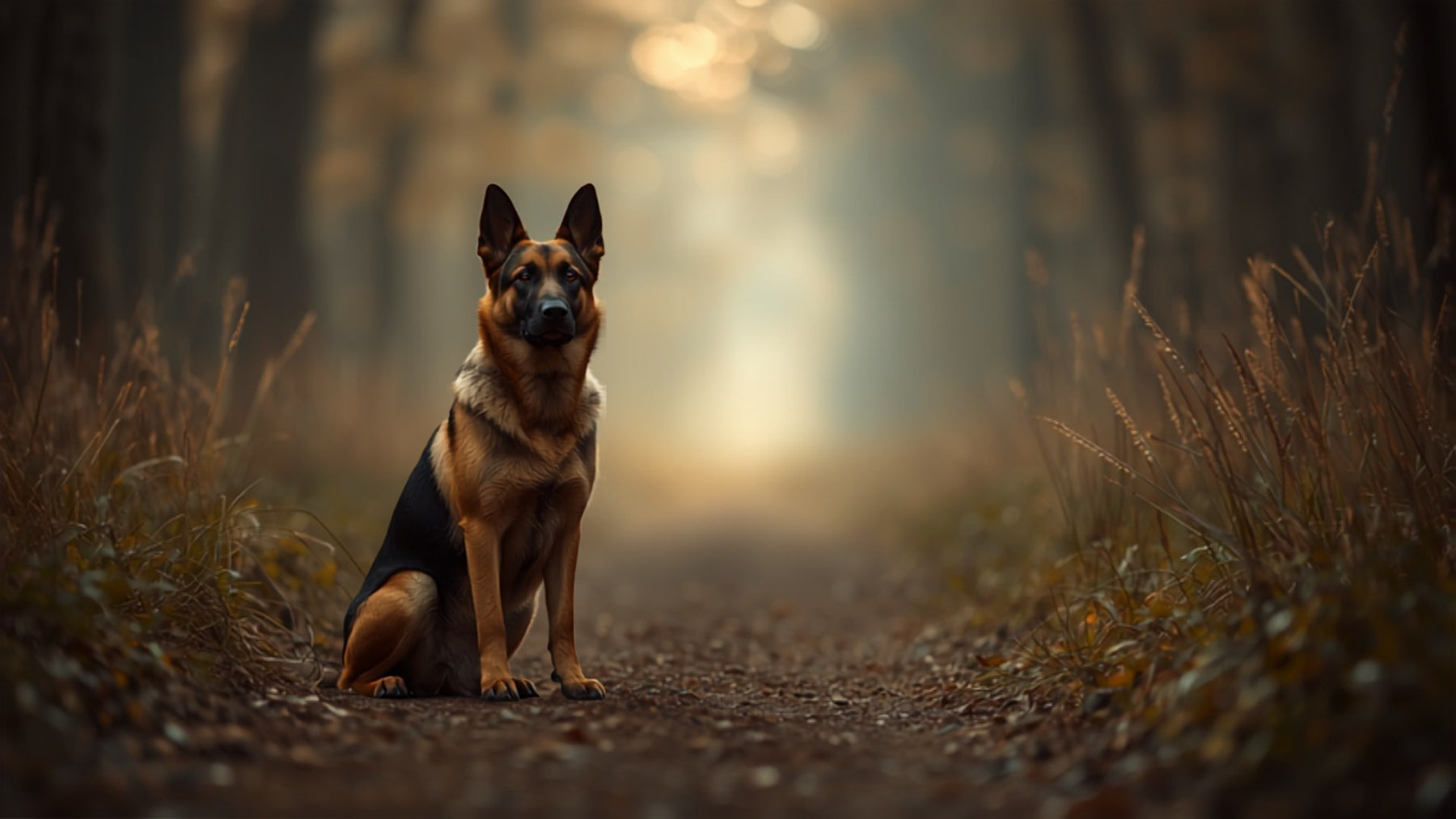
There is hardly an image that sits so deep in the German memory: the shepherd dog next to the police officer, in front of the farm, at the fence. Intelligent, loyal, incorruptible. The German Shepherd has been in the top 3 of the VDH puppy statistics for decades and is one of the most commonly kept breeds worldwide. There are no nationwide statistics in Germany on which breeds end up in animal shelters and how often. What is clear, though: this dog is wonderful if you understand him, and hard work if you underestimate him.
The video
Clicking loads the video from YouTube. Data is transferred to YouTube (Google) in the process. Privacy policy
Breed facts
- Origin: Germany, developed in 1899 by Max von Stephanitz from herding dogs as a working dog
- Size: Males 60 to 65 cm, females 55 to 60 cm
- Weight: 22 to 40 kg
- Life expectancy: 9 to 13 years
- Coat: Medium-length or long outer coat with a dense undercoat, usually black and tan or grey
- Temperament: Willing to work, watchful, eager to learn, closely attached to one person
Temperament: a dog that wants a job
The German Shepherd was bred as a working partner rather than a family pet, and you notice it every day. Watching, alerting, wanting to know what happens next. Without a task, a German Shepherd invents one: guarding the garden fence, controlling visitors, organising children. Give that dog structured work instead, such as scent work, obedience, tracking or mantrailing, and you have one of the most trainable dogs there is.
Many German Shepherds bond especially closely with one person. Others, they often treat kindly, but not with the same devotion. That is wonderful if you are that person, and can become a problem if that person does not take responsibility for training.
Five things to consider before buying a puppy
1. Hips are the big issue
Few breeds are as closely associated with hip dysplasia as the German Shepherd. Elbow dysplasia also occurs, along with degenerative myelopathy in older dogs, a spinal cord disease for which a genetic test is available. A responsible breeder shows you both parents’ hip and elbow results (HD A or B, nothing worse) and the DM genetic test. Anyone unable to do so is not breeding responsibly, however lovely the puppies are. The extremely sloping back in some show lines is also a health problem rather than a beauty feature. Working lines usually have a straighter back.
2. They shed. Always. Everywhere.
German Shepherds do not shed twice a year. They shed all year, with two extreme periods. If you want a clean home, you need a plan: daily brushing during shedding, otherwise two to three times a week, and a vacuum cleaner that means business.
3. Watchfulness is not aggression, but...
A German Shepherd announces when someone is coming. That is the breed, not a training mistake. A German Shepherd who no longer lets visitors into the flat, on the other hand, needs help. Often training and clear routines are missing, sometimes insecurity or pain is behind it. Get a trainer or a veterinary behaviourist involved early. The line is drawn in the first 18 months: socialisation with lots of people, clear rules about who decides, and a main person who stays calm. If you do not feel up to that, you should not choose this breed.
4. This is not the child-friendly dog from the films
Yes, many German Shepherds are wonderful with children. But their herding instinct can focus on running children, and their size means a collision becomes a fall. Children and German Shepherds work together when adults set the rules and supervise, rather than letting the dog decide.
5. Show line or working line
There are effectively two breeds under one name. Show lines are heavier and calmer, often with a sloping back. Working lines are leaner, much more driven and often too much for an ordinary family home. Ask the breeder which lines the parents come from and what work they do. A dog from a service-dog line is not a beginner’s dog.
What a German Shepherd needs every day
- Daily mental work. 20 minutes of scent work is more tiring than an hour of throwing a ball. Ball throwing only makes the dog more frantic.
- Two to three hours of exercise, but gentle on the joints: no racing up stairs, no jumping in the first year and no running alongside a bicycle before the 15th month.
- One clear main carer, with time to spare. This is not a dog to leave alone for eight hours.
- Weight management. Every extra kilo puts pressure on the hips.
- A place with a view. German Shepherds want to see what is happening. A spot in the hallway is preferable to the loveliest bed in a storage room.
Who is a German Shepherd right for?
People who take part in dog sports or want to start. Active households with a garden and time. Owners with experience or a willingness to gain it with a good trainer. Not people working full-time without daytime care, or those wanting an easy-care dog that gets along with everyone.
If you are choosing between a German Shepherd and two or three other breeds, a breed list rarely gets you far. We built “Welcher Hund passt WIRKLICH zu dir?” (book in German) the other way round: your daily routine, your home and your available hours first, then the breed.
Frequently asked questions
Is the German Shepherd a dog for beginners? With a good dog school and lots of time: possible. Without both: no.
How much does a puppy cost? From a VDH breeder with health results, 1,200 to 2,000 euros. Whatever the price: ask to see the HD and ED results of both parents.
Can he live in a flat? Yes, if he gets enough exercise outside. The flat is for sleeping, not for romping.
How long does he live? On average 10 to 12 years. Healthy joints and a slim figure can help him stay fit for a long time.
The German Shepherd as a portrait subject

The attentive gaze, the pricked ears, the black-and-tan markings: hardly any dog looks as dignified in a portrait as a German Shepherd. In the example above, Oskar is drawn in Sketch style, which carries the ears and the gaze entirely without colour. If you want to emphasise the black-and-tan markings warmly, choose the classic oil painting style. For the photo: make a quiet sound for the ears and shoot slightly from below so that he looks big.
A German Shepherd fills a wall. On framed canvas like Oskar's, the picture hangs without buying another frame; in a wooden frame above the sideboard it looks more classic. Both and the other formats are in our dog portraits. You see your picture beforehand and tell us what you would like changed.
For the first weeks with a German Shepherd puppy, our Puppy Starter Pack PDF includes a weekly plan, socialisation bingo and a house-training log.
Further reading
- Rottweiler: a restricted breed and 45 kilos of responsibility: another dog discussed more often than understood
- When the cleverest dog has no job: a herding dog’s mind and the same basic question about purpose
- Puppy biting: teaching bite inhibition: because a German Shepherd puppy needs to learn boundaries early
The links to our books are affiliate links. Buying through them supports us at no extra cost to you.


