

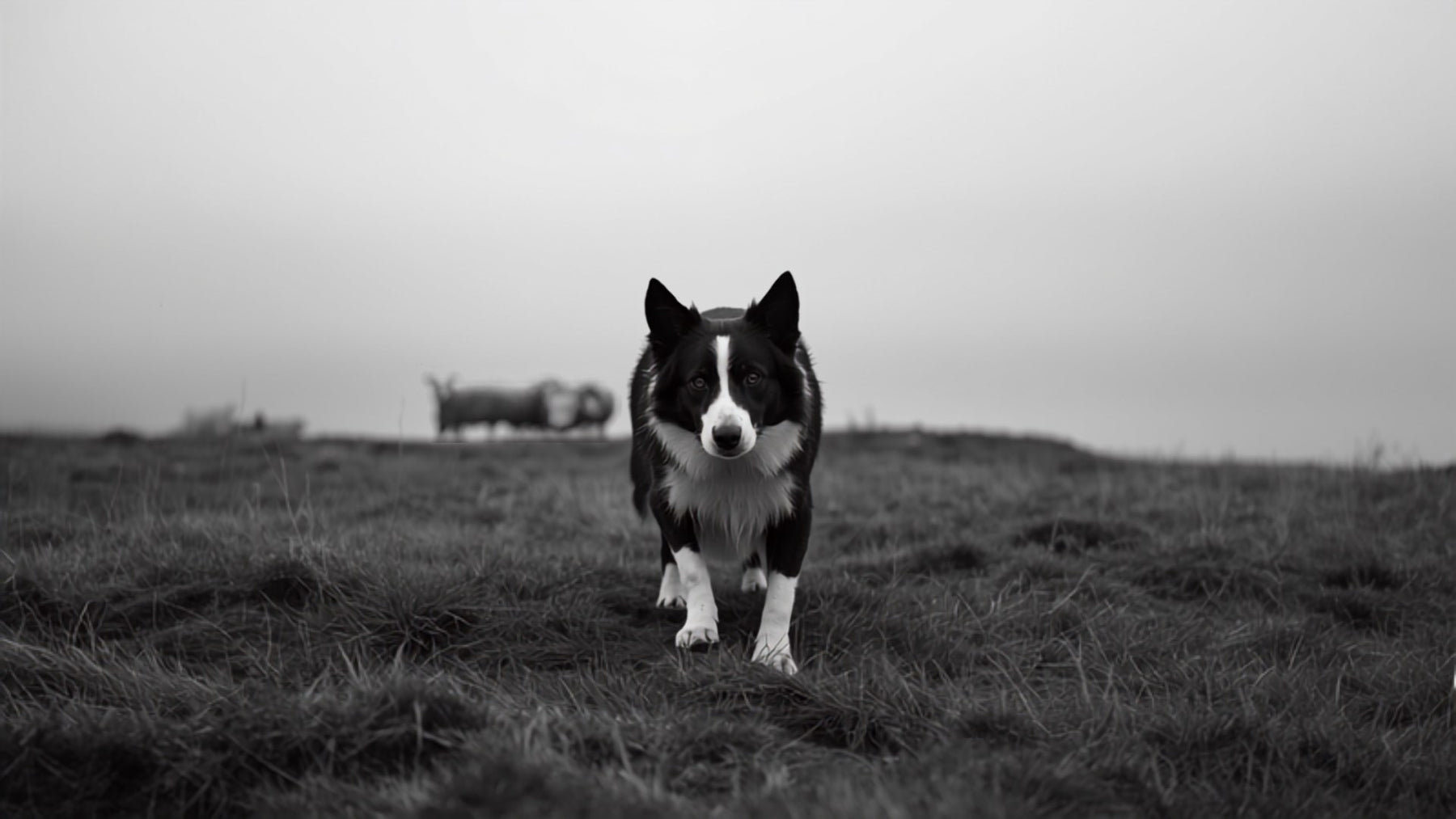
He lies flat, his head just above the ground, and stares. Not at you, but at the door, the ball, the child who is about to run off. This look has a name: "the eye". It comes from herding work and is nothing other than a hunting sequence from which the final step has been bred out over generations. Stalking and fixing are still there, the grabbing is gone.
The video
Clicking loads the video from YouTube. Data is transferred to YouTube (Google) in the process. Privacy policy
A Border Collie doesn't do this because he is badly trained. He does it because his brain was built for exactly that. And this is exactly where the thing begins that leads owners to a trainer two years later.
The thing about intelligence
The Border Collie's reputation as the cleverest dog breed goes back to the ranking by the psychologist Stanley Coren. It measures one very specific thing: how quickly a dog learns a new command and how reliably he carries it out on the first attempt. That is not the only form of intelligence a dog can have, but it is exactly the one that shapes everyday life with this breed.
In practice this means: he learns in just a few repetitions. Including things you didn't mean to teach him. That the lead on the hook means a walk, that car keys mean leaving, that a certain sound in the kitchen means cheese. He makes connections faster than you can correct them, and he doesn't like to forget.
Profile
- Height at the withers: males about 53 cm, females slightly smaller (VDH, accessed on 19.09.2026)
- Weight: usually given as 14 to 22 kg; the standard gives no figure
- Life expectancy: 12.1 years according to the VetCompass life tables of the Royal Veterinary College (2022, British data)
- Coat: medium-length or short, with undercoat, moderate grooming
- Origin: the border country between Scotland and England, bred as a sheep herding dog
The most common mistake in thinking: more is not better
The obvious reaction to an under-occupied Border Collie is: more exercise. Another round of ball, another hour next to the bike, another training ground. The result is usually a dog who doesn't get calmer, but fitter and quicker to become irritable.
What actually helps is a change of category. Not more stimulation, but different stimulation: search tasks that involve mental work, impulse control, properly built-up distance work, short sequences with a clear beginning and a clear end. And afterwards, just as important, trained calm. A Border Collie who hasn't learnt to switch off in a busy room sleeps too little and therefore reacts to ever smaller triggers.
Two to three focused sessions a day plus exercise plus deliberately required rest periods are a realistic framework. Constant entertainment is not keeping him busy, it is the first step towards overexcitement.
The hereditary diseases to ask the breeder about
The Border Collie is considered a robust breed, but it has an unusually well-documented list of hereditary diseases for which gene tests exist. That is exactly why you can ask very specific questions here.
- CEA (Collie Eye Anomaly): eye disease with changes to the retina, ranging from inconspicuous to blindness. Gene test available since 2004.
- TNS (Trapped Neutrophil Syndrome): autosomal recessive immunodeficiency. Affected puppies usually die in the first months of life. Carriers can be identified by testing.
- CL (Ceroid Lipofuscinosis): rare, fatal metabolic disease. Symptoms typically begin around the 18th month of life.
- IGS (Imerslund-Gräsbeck Syndrome): disorder of vitamin B12 absorption, treatable by supplementation.
- HD: graded from A to E. Under the breeding rules, dogs from grade C upwards are excluded from breeding.
- PRA: progressive retinal degeneration, starts as night blindness.
Gene tests exist for CEA, TNS, CL and IGS. A breeder who has done them will show you the results without being asked. That is the simplest filter you have.
MDR1 is rarer in the Border than his reputation suggests
The MDR1 defect is often mentioned in the same breath for the Border Collie and the Australian Shepherd. The figures say something else. In a German study of 7,378 tested dogs (Gramer and colleagues, Veterinary Journal 2011), the frequency of the defective gene in the genome (allele frequency) was 1 per cent in the Border Collie and 22 per cent in the Australian Shepherd. The University of Zurich gives 1 to 2 per cent for the Border Collie and 17 to 46 per cent for the Aussie. These are shares of the gene, not shares of sick dogs. Only a gene test shows whether your dog is affected.
Rare does not mean irrelevant. Affected dogs are hypersensitive to active substances such as ivermectin, doramectin, orally given moxidectin and loperamide. How strongly a dog reacts depends on the genotype, the active substance and the product, and which drugs are safe for your dog is decided by the veterinary practice. A gene test costs little, is valid for life and belongs before the first deworming and before any planned anesthesia.
Epilepsy, the hardest part
According to the consensus in veterinary neurology, idiopathic epilepsy occurs more often in the Border Collie than in the general dog population. We do not have a reliable breed-specific prevalence figure. What is well documented is the course of the disease, and in this breed it is severe.
An analysis of 114 affected Border Collies, published in Frontiers in Veterinary Science in 2022, arrives at a median age of onset of 33.5 months, with a range of 6 to 188 months. 59 per cent of the dogs had cluster seizures, 29 per cent status epilepticus. 60 per cent needed at least two medications, and 81 per cent had side effects under treatment. An older German study by Hülsmeyer and colleagues (2010) gives an average age of onset of 2.4 years.
To this day there is no gene test for it. What remains is asking the breeder whether seizures are known in the line, and being prepared, if it comes to it, to live with a chronically ill dog.
What he costs
A puppy from a responsible breeder costs around 1,200 to 2,500 euros, depending on the pairing and the extent of health testing (market observation from breeder and portal listings, accessed on 19.09.2026, not official statistics). The bigger item is a different one anyway: this breed costs time, every single day, over twelve years.
If you are weighing up whether it really should be a Border Collie: our book „Welcher Hund passt WIRKLICH zu dir?“ asks the questions that should come before buying a puppy.
Frequently asked questions
Is the Border Collie a good dog for beginners?
Mostly not. Not because he is difficult, but because mistakes have consequences faster with him than with other breeds. With a trainer's support from week one, it is doable.
Can he live in the city?
Yes. The problem is rarely the flat, but mostly the diary. The city does mean more stimuli, though, and that makes calm training even more important.
Does he need sheep?
No. He needs a task with structure. Herding work is one option, scent work, obedience or trick dogging are others.
Why does he herd children and bicycles?
Because movement invites it and nobody else tells him what to do. This is one of the few points where interrupting early and consistently really matters.
On the portrait

With a Border Collie, the photo decides everything. The black-and-white head is a contrast problem, and the half-folded ears like to disappear into the dark fur. It works best outdoors in the shade, at eye level, shortly after he has done some work and is sitting still for a moment. In the example above, Nala hangs as a watercolour on a poster: the soft gradients let black and white flow into each other instead of drawing hard edges. If you want more contrast, take a look at the cartoon style, which draws the alert expression more clearly. For a more ceremonial look, there is the Royal style. When you order, you already see your design in the live preview; if you have a special request, you get a personal preview by email before printing. 20% of our profit goes to animal welfare.
A Border Collie puppy learns from day one, including things you never meant to teach him. How to build up the first weeks calmly is in the free starter pack "The first 30 days".
Read on
- Australian Shepherd, the direct comparison, more watchful and with a much higher MDR1 risk
- Jack Russell Terrier, the same energy in a small size, but without the herding stare
- Golden Retriever, in case you realise you are looking for a cooperative dog rather than a demanding one
Sources, accessed on 27.10.2026: Gramer I et al., Breed distribution of the nt230(del4) MDR1 mutation in dogs, The Veterinary Journal 2011; University of Zurich, CliniPharm Pharmakogenetik: MDR1 / ABCB1-Defekt; Santifort KM et al., Phenotypic Characterization of Idiopathic Epilepsy in Border Collies, Frontiers in Veterinary Science 2022; Hülsmeyer V et al., Epilepsy in Border Collies: clinical manifestation, outcome, and mode of inheritance, Journal of Veterinary Internal Medicine 2010; Teng KT et al., Life tables of annual life expectancy and mortality for companion dogs in the United Kingdom, Scientific Reports 2022 (VetCompass, life expectancy).
The links to our books are affiliate links. If you buy through them, you support us at no extra cost to you.


