

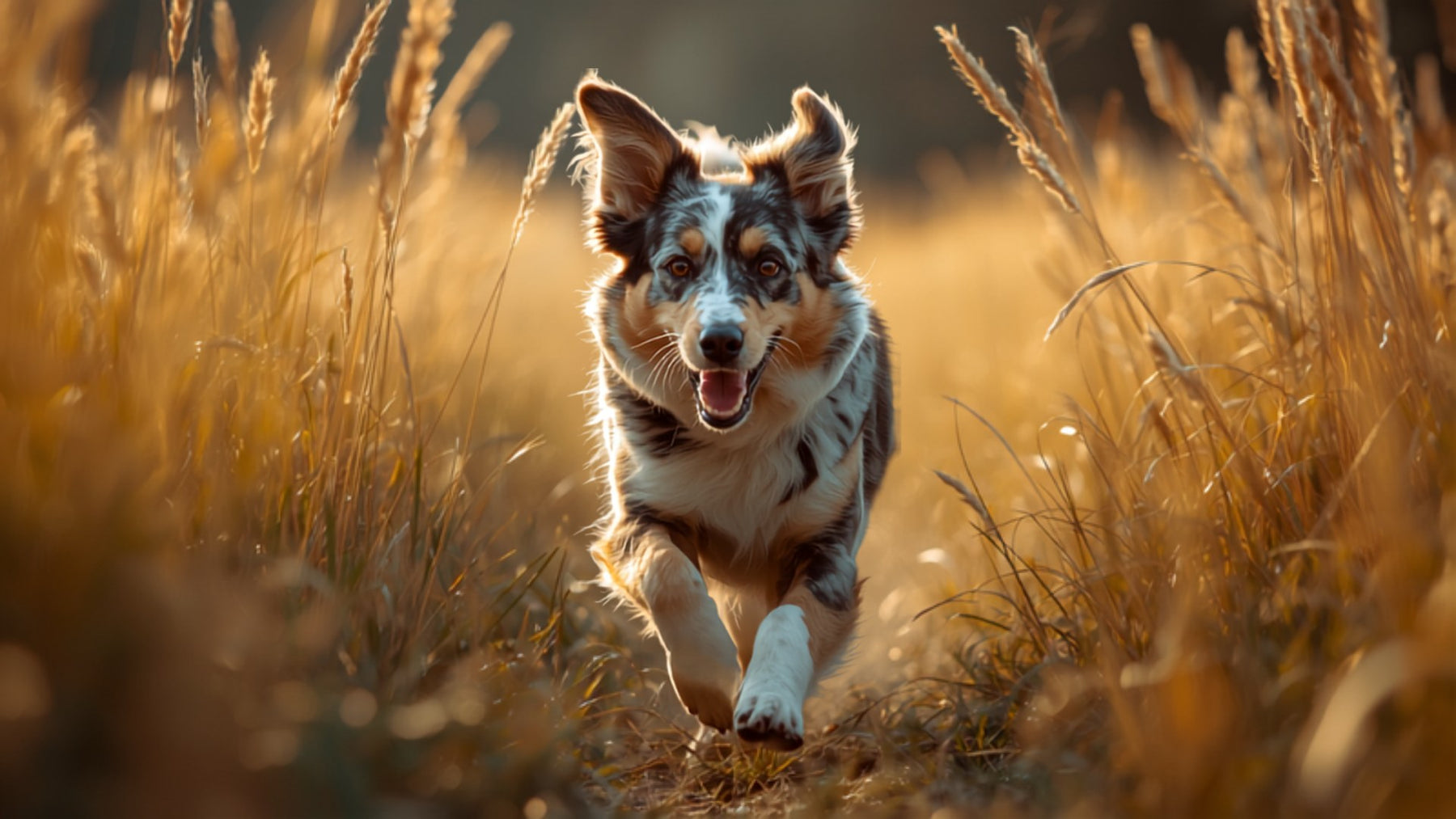
The name is misleading. The Australian Shepherd comes from the USA, not Australia. Basque shepherds brought its ancestors from Australia to America around 1800. The breed we know today developed on American ranches, and the Western riding scene made it famous after the Second World War. This is more than quiz-night trivia. It explains why this dog is built the way it is: for long days, changing tasks and a person always within sight.
The video
Clicking loads the video from YouTube. Data is transferred to YouTube (Google) in the process. Privacy policy
You notice it in a scene almost every Aussie owner recognises. A cyclist approaches, and the dog lowers its body. No barking, no leap, just that crouch and the movement around the bend. It is neither aggression nor play. It is work nobody asked the dog to do.
How herding instinct plays out in everyday life
A herding dog without a herding job looks for movement it can control. In town, that means joggers, cyclists, children and cars. If this is not guided into calm channels early, it can become more than a cute quirk: a dog that goes on alert at many movements, and neighbours who cross the road.
At the same time, Aussies bond very closely with their own people and are often reserved with strangers. They were also kept as watchful farm dogs, and that vigilance remains. An Aussie that greets every visitor enthusiastically is the exception rather than the rule, and that is not a training failure.
The VDH sums up their needs in two words: daily action. That means more than running. Brain games, agility, obedience, scent work and carefully taught tricks all fit. Then, to make it work, comes a deliberately practised period of rest. An Aussie that never properly switches off between training sessions becomes more sensitive, not more balanced.
The basic facts
- Height at the withers: Males 51 to 58 cm, females 46 to 53 cm (VDH, accessed on 19.09.2026)
- Weight: usually given as 16 to 32 kg; the standard specifies no weight
- Life expectancy: usually given as 12 to 15 years. We do not have a large epidemiological analysis with Aussie data, so this range is a guide rather than a study finding.
- Coat: medium-length with an undercoat; regular brushing needed, sheds noticeably
- Temperament: confident, watchful, athletic and strongly attached to their own people
MDR1: the test to do before the first worming treatment
The MDR1 defect is no side issue in the Australian Shepherd. In a German study of 7,378 tested dogs (Gramer and colleagues, Veterinary Journal 2011), the frequency of the defective gene in the genome (allele frequency) was 22 percent in the Australian Shepherd and 1 percent in the Border Collie. The University of Zurich gives a range of 17 to 46 percent for the Aussie and 1 to 2 percent for the Border Collie. Important: this is not the share of sick dogs. How many dogs carry the defect twice (homozygous, often severe reactions) or once (carriers, according to the University of Zurich rarely reactions) cannot be read directly from it. That is why the genetic test of your own dog is what counts.
Affected dogs cannot transport certain active substances out of the brain. How a dog reacts depends, among other things, on the genotype (one or two altered copies), the active substance, the product and the way it is given. Ivermectin, doramectin, orally given moxidectin and loperamide are considered critical. With milbemycin oxime and emodepside, the dose matters, and your veterinary practice sets it. For acepromazine, butorphanol, ondansetron, erythromycin and various cytostatic drugs as well, clearly increased side effects up to and including poisoning have been described in affected dogs. Which drugs are safe for your dog is decided by the veterinary practice based on genotype, active substance and product. So do not give anything on your own, and tell your veterinary practice before every treatment whether your dog has been tested for MDR1.
In practical terms, the genetic test should be done before the dog’s first worming treatment, and the result should go in the vaccination record. An emergency vet at three in the morning has little time for lengthy questions. Many responsible breeders already provide the puppy’s MDR1 status. If not, ask before signing the purchase contract.
Merle: what the pattern means genetically
The lightened, mottled pattern that first attracts many people to the breed is located at the M locus and is inherited dominantly. One copy is enough for the visible pattern. Dogs with only one merle copy can also be deaf, but this happens much less often than with two copies.
The problem arises with two copies. Mating two merle dogs statistically produces 25 per cent homozygous puppies, known as double merles. The merle gene interferes with pigment formation, and that also affects the inner ear and the eye. In a US study of 153 merle dogs of various breeds (Strain and colleagues, 2009), 15 per cent of the double merles were deaf in both ears and 10 per cent in one ear; of the dogs with one merle copy, 0.9 per cent were deaf in both ears and 2.7 per cent in one ear. Double merles also frequently have malformations of the eyes, up to and including impaired vision. For your individual puppy these figures say nothing: a hearing test at the vet does.
In Germany, the expert report on torture breeding (Qualzucht) by the Federal Ministry of Agriculture on § 11b of the Animal Welfare Act recommends a breeding ban on mating two merle dogs. Austria and Switzerland have their own animal welfare rules; the competent veterinary authority gives binding information (as of 27.10.2026). Responsible breeding mates a merle dog only with a dog whose non-merle status is genetically confirmed, and this applies to all parent animals involved. A solid-colored coat alone is not enough for this, because there is hidden (cryptic) merle with barely visible or invisible markings. Whether a mating is justifiable is judged by qualified breeding and veterinary experts based on the test results. If you are offered a litter in which both parent animals are patched, that is no coincidence and no special offer, but a reason to end the conversation.
What an Aussie costs
A puppy from a responsible breeder in Germany costs around 1.000 to 2.200 euros (market observation based on breeder and listing-site information, accessed on 19.09.2026, not official statistics). Ongoing costs total roughly 80 to 155 euros a month, depending on feeding, plus 30 to 150 euros a year in German dog tax, depending on the municipality.
Unusually expensive offers for rare colours are a warning sign, not a mark of quality. Colour is not a breeding goal; health is.
If you are weighing up a herding dog and something calmer, our book “Welcher Hund passt WIRKLICH zu dir?” (book in German) helps you think it through before instinct takes over.
Frequently asked questions
Aussie or Border Collie?
Aussies are generally more watchful and reserved with strangers, while Borders are more sensitive and even more absorbed in work. Their MDR1 risks are very different. Read more in the Border Collie profile.
Is the Australian Shepherd suitable for first-time owners?
Only with a trainer’s support and an honest assessment of your time. Their looks sell them far more easily than their temperament makes them to live with.
How long can an Aussie stay alone?
A few hours with careful training. This is a dog that seeks company, and long periods alone are the most common starting point for barking and restlessness.
Do they shed a lot?
Yes. An undercoat means two intense shedding periods a year and hair on dark clothing all year round. Brushing two to three times a week keeps it manageable.
And in a portrait?

Two things regularly get lost in Aussie photos: the fine transitions in the merle pattern and the brightness of blue eyes. In the example above, Juno is shown in street art style: the splashes of colour pick up the colourfulness of the merle pattern, and acrylic glass gives the light areas depth. If you prefer something softer, choose the watercolour style, which lets the fine transitions flow more gently. Send a photo, look at the preview, have it changed, then print. 20% of our profit goes to animal welfare.
Before your Aussie puppy moves in, take a look at our Puppy Starter Pack: 58 printable pages, from the countdown to the end of the first month, free.
Further reading
- Border Collie, the closest relative in mindset rather than looks
- Labrador Retriever, if you want activity without the watchfulness
- Puppy training: the 5 rules, because herding dogs learn in their first months what they will react to for the rest of their lives
Sources, retrieved on 27.10.2026: Gramer I et al., Breed distribution of the nt230(del4) MDR1 mutation in dogs, The Veterinary Journal 2011; University of Zurich, CliniPharm Pharmacogenetics: MDR1 / ABCB1 defect; Strain GM et al., Prevalence of deafness in dogs heterozygous or homozygous for the merle allele, Journal of Veterinary Internal Medicine 2009; Federal Ministry of Food, Agriculture and Forestry, Expert opinion on the interpretation of § 11b of the Animal Welfare Act (torture breeding report), 1999.
The links to our books are affiliate links. Buying through them supports us at no extra cost to you.


