

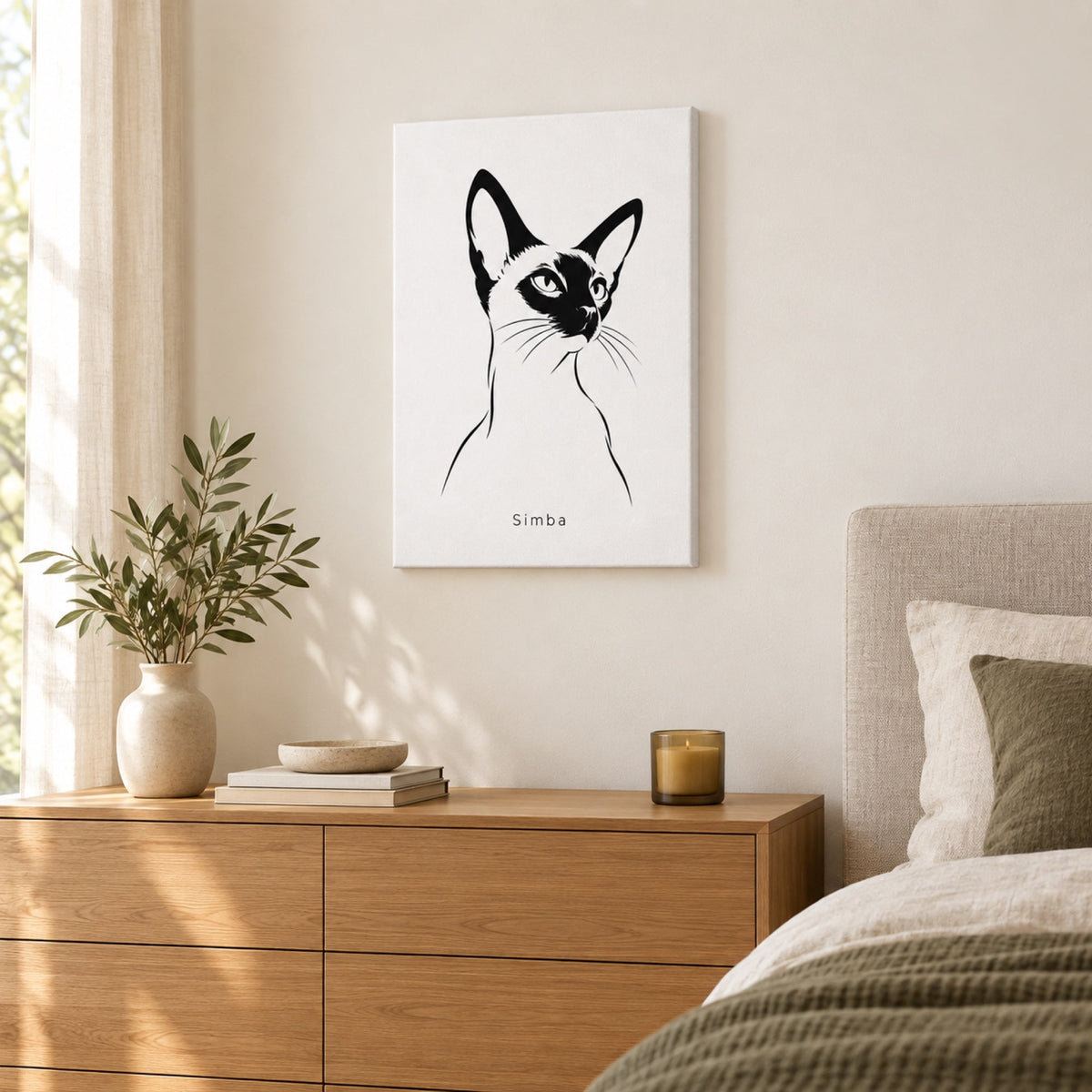
You have four hundred photos of your cat on your phone. Three hundred show her asleep. In eighty, she is a blurry shape on her way to the food bowl. In the remaining twenty, she looks away just as you press the shutter, as if she heard the camera before it clicked. People who want to order a cat portrait from a photo rarely get stuck choosing a provider. More often, it is the photo that gives them pause, or the worry that none of them is good enough.
The situation is better than it looks. A portrait does not need a perfect photo. It needs one that makes this particular cat recognisable. Here is what that means for cats and what to consider when you place your order.
Cat portrait from a photo: what makes your cat recognisable?
With dogs, it is often the ears or the muzzle. With cats, it is almost always the eyes: their colour, shape and distance from each other, whether they are slightly slanted or round like marbles. Green irises and copper-coloured irises can make two black cats look like completely different animals. Then there are facial markings: the M on a tabby’s forehead, a white patch on the chin, a pink or grey nose.
That leads to the most important rule when choosing a photo: a picture with clear eyes and a messy background is better than a lovely setting and half-closed eyelids. A portrait replaces the background anyway. It cannot replace the eyes.
Why cats rarely look into the camera
Among cats, a long, direct stare is not a friendly signal. Many cats avoid a lens that is pointed at them, turn their heads away or blink slowly. It is not stubbornness. It is good manners in cat language. For your photo, that means you do not have to wait for your cat to look at you. A gaze just past the camera, perhaps towards a window or a hand holding a treat, works just as well for a portrait as long as both eyes are visible.
Our guide to taking a photo of your cat without stress explains how to get one in a few minutes. The essentials are daylight from a window, the camera at your cat’s eye level, which usually means getting down on the floor, and patience instead of making noises.
Indoor or outdoor cat: two different photo situations
For an indoor cat, the main problem is usually the light. Under a ceiling light in the evening, the pupils grow large and black, the eye colour disappears and the fur looks yellowish. The best photos are taken during the day by a windowsill, where many indoor cats already have a favourite spot. The pupils are narrower there, and the iris shows its real colour.
For cats that go outdoors, the light is often good, but the cat rarely stays in one place for long. Try taking a photo after she comes back, when she is sitting on the steps or windowsill and checking her surroundings. Avoid backlighting. The sun should come from the side or from behind you. A photo from summer is still a good photo in winter. You may already have the right one in your gallery.

Coat colours that can be tricky
Black. In photos, black cats can look like a silhouette with two eyes. That is no reason to give up, but it does make light especially important. Soft daylight from the side brings out the texture of the fur. When choosing a style, strong contrasts or a light background can help the cat stand out.
White. The opposite problem. In strong sunshine, white fur can become a bright area with no detail. Shade or an overcast day works better. A pink nose and ears often give a white cat’s face its character. Make sure they are not washed out in the photo.
Tabby. The stripes are a key identifying feature, especially on the forehead. A front-facing photo shows them best. A profile shot can lose half of the pattern.
Tortoiseshell and calico. Each patch has its own place, and that is exactly what makes the cat unique. A portrait should preserve how the colours are arranged on the face. In the preview, check whether the orange patch above the left eye is still on the left.
Preview: your most important check
With cats in particular, it helps to choose a provider that lets you see the finished design before it is printed. The details that make a cat recognisable are small: a patch, an eye colour, the shape of the nose. With our cat portraits, you upload your photo on the product page, choose one of 12 styles and see the style and name in the live preview. If you have a special request, you also get a personal preview by e-mail before printing. If a marking or eye colour is not right, we adjust the design until you are happy.
Check three things in the preview. First, the eye colour: is it right, or has green turned yellow? Second, the facial markings, including stripes, patches and nose colour. Third, the expression. A cat that is calmly blinking in the photo should not suddenly look ready to attack in the portrait.
Which material suits which cat?
The choice depends less on the cat than on the room. A poster is an affordable way to start and suits a wall that already has frames. Canvas looks calm and homely without a frame. A poster in a wooden frame is ready to hang and makes a safe gift choice. Acrylic glass makes colours glow, which can look especially good with bold styles and cats with vivid eyes.
For reference, as of 23.10.2026: our cat portraits start at 23,99 € for a poster, 39,99 € for canvas, 49,99 € for a poster in a wooden frame and 54,99 € for acrylic glass. The amount shown at checkout before payment is binding. Printed in Germany and Europe, with delivery to Germany usually taking 5 to 9 working days.
A quick thought about size: cat portraits are often ordered too small because cats are small animals. But the picture hangs on a wall, not beside the cat. A size that looks large on a screen can quickly seem lost above a sofa.
Frequently asked questions
Is a phone photo good enough for a cat portrait? Yes, in most cases. What matters is that both eyes are sharp and well lit. You can see in the live preview whether it works; if it doesn’t, we’ll get in touch before printing.
My cat never looks at the camera in photos. Will that still work? Yes. A gaze just past the camera works well as long as both eyes are visible. A full profile is harder because it often hides half of the facial markings.
Can you make a portrait of a black cat? Yes, if the photo was taken in daylight and the eyes are easy to see. A high-contrast style or a light background helps the cat stand out.
Can I put my cat and dog together in one picture? Yes. There is a dedicated wall picture with a dog and cat together. For other combinations, you can use the special request form.
Can I make a memorial portrait of a cat that has died? Yes. Our guide to a memorial portrait of a pet explains how to choose the right photo and where the picture might look good.
It is worth scrolling through your gallery
Before taking a new photo, spend ten minutes looking through the pictures from the past two years. Do not search for the prettiest one. Look for the one where the eyes are clearest. It may be a snapshot you never thought much of: your cat on the windowsill on a grey afternoon, just before she looks away again. That is often the photo that makes a portrait feel like her. If you are also looking for a gift for another cat lover or a guide from our books, you can find both here.
Read next
- Taking a photo of your cat without stress: how to get a portrait-worthy picture
- Gifts for cat lovers: 7 ideas for people and cats
- Giving a pet portrait: occasions, styles and what people appreciate
Sources: prices, styles and delivery times according to our shop, as of 23 October 2026.
SELBSTPRÜFUNG: Gedankenstriche 0 · Herstellungsweg 0 · hrefs unverändert ja · pmp-faq vorhanden ja


