

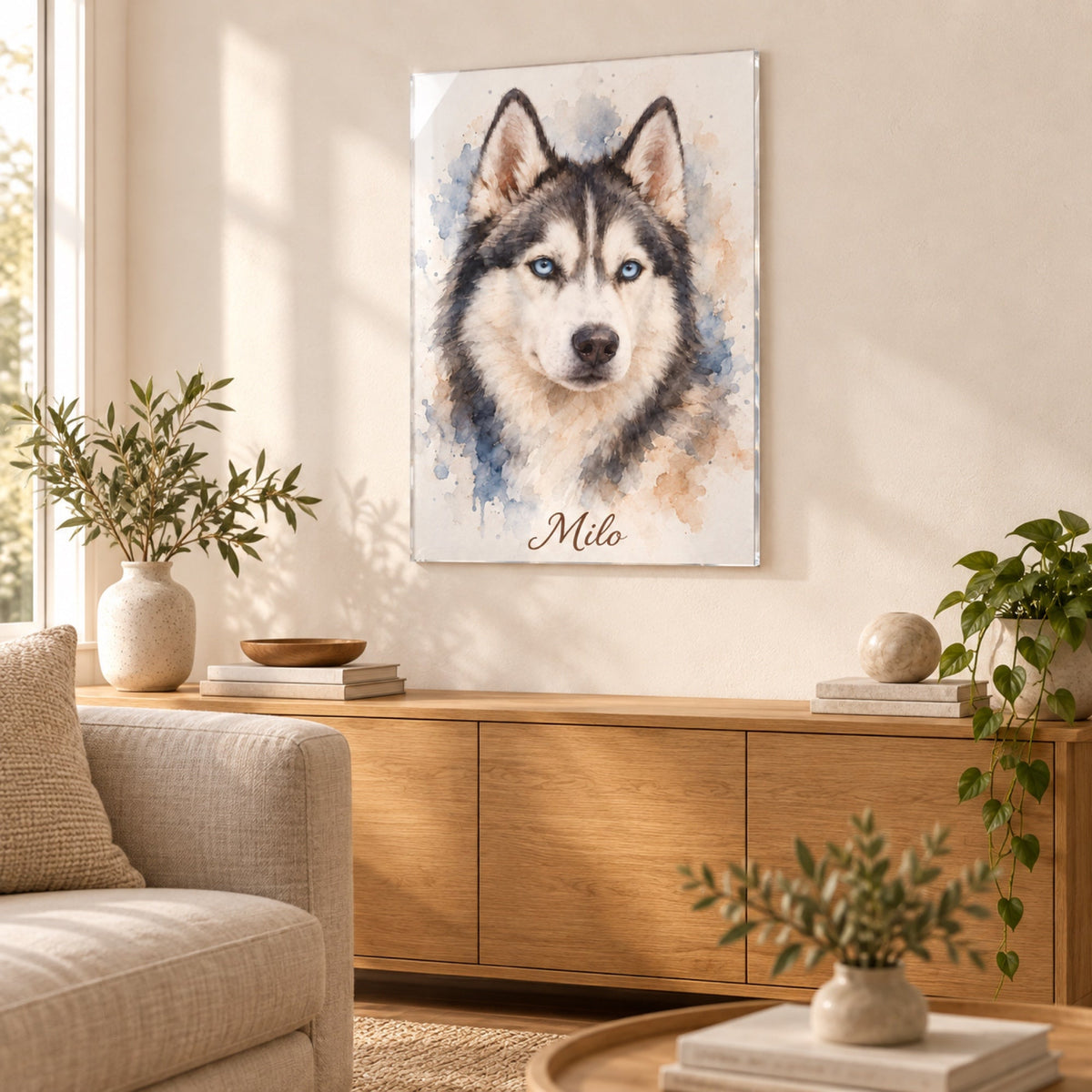
You have chosen the photo, settled on the style and typed in the name. Then comes the question that catches more people than you might expect: poster, canvas or acrylic glass? Three finishes, the same image, and all three look good in the shop. On a wall, they look very different. The material determines whether your dog looks calm and warm above the sofa or cool and modern, whether the cat brightens the hallway or disappears in reflected light, and whether the horse portrait lasts in a stable.
The good news is that there is no wrong choice, only one that suits your room better. Six questions will help you decide in about five minutes.
Canvas or poster for a pet portrait: the six finishes
- Poster: matte premium paper at 200 gsm, supplied without a frame and sized to fit standard picture frames.
- Poster in a wooden frame: the same matte paper, already mounted in a pine frame with acrylic glass in front, available in black, dark wood, light wood or white.
- Canvas: cotton and polyester fabric stretched over a 2 cm deep FSC wood frame, with hanging hardware included.
- Framed canvas: canvas in an FSC wood floating frame, set 12 mm away from the frame so the image seems to hover slightly.
- Acrylic glass: glossy 4 mm acrylic glass, mounted with screws in all four corners.
There is also a quieter sixth option: a 5 mm foam board. It is light and rigid, with a hanger included, and gives a neat look without a frame.
Question 1: How much light reaches the wall?
This is the question people most often forget, and it matters more than any other. Glossy surfaces reflect light. If your acrylic glass is opposite a large window, you may see the garden instead of your dog during the day, depending on the angle. In the evening under a warm lamp, though, the colours glow and dark shades gain a depth that paper cannot match. That is why bold styles such as Pop Art look especially strong on acrylic glass, and why cat’s eyes seem to shine.
Canvas and posters are matte. They barely reflect and look the same from every angle. If the picture will hang on a bright wall opposite a window, they are the reliable choice. One exception is the poster in a wooden frame: the paper is matte, but acrylic glass protects it from the front. It reflects too, though the frame draws the eye inward and makes the glare less noticeable.

Question 2: What kind of effect do you want?
The same watercolour Labrador feels like a picture that has always been there on canvas. The fine texture of the fabric softens the print, the edges of the stretcher frame add depth, and it suits wood, wool and warm light. In a wooden frame, it looks tidier and more classic, almost like a family photo in the grandparents’ hallway, only better. On acrylic glass, it feels modern, crisp and a little cool, like art in a white-walled gallery.
| Finish | Effect | Works especially well in |
|---|---|---|
| Poster | light, flexible, understated | your own frame, a rented home, a small budget, a second picture |
| Poster in a wooden frame | classic, neat | hallway, home office, gallery wall with several frames |
| Canvas | warm, homely, calm | living room, bedroom, watercolour and oil-painting styles |
| Framed canvas | elegant, gallery-like | meaningful gift, memorial portrait, large format |
| Acrylic glass | brilliant, modern, vivid colours | Pop Art, Street Art, Retro, rooms without strong direct reflections |
| Foam board | simple, frameless, very light | stable, tack room, children’s room, quick hanging |
Question 3: How big is the wall, really?
Every finish is available up to 60 by 80 cm. The smallest size is either 20 by 25 or 20 by 30 cm, depending on the material. Posters, wooden frames and standard canvas come in portrait and landscape formats. Acrylic glass, foam board and framed canvas come in portrait format.
Landscape is often better above wide furniture. It fills the space above a sofa or sideboard without adding height. A dog lying down, a cat stretching on a windowsill or a horse in profile with a long neck can look especially good in this format. A portrait showing the head and chest, on the other hand, belongs in portrait format.
Do not underestimate the space. Cut a piece of packing paper to the size you are considering and tape it to the wall. In two minutes, you will see whether the picture has presence or gets lost. Most people go one size larger after trying this.
Question 4: Drill, stick or simply lean it against the wall?
Canvas hangs from a nail or hook, and hanging hardware is included. The foam board is so light that it can hang in places where a heavy picture would not be suitable. Acrylic glass needs four drilled holes because it is fixed with screws in all four corners. In return, it sits perfectly straight and is hard to knock off by accident. If you rent and would rather not drill, keep that in mind.
A poster without a frame is the most flexible option. You can put it in a frame you already own, hang it with poster rails or leave it on a shelf for now. When you move, it is safe in a cardboard tube.
Question 5: Where will it hang, and what does it need to withstand?
A living room is easy on a picture. A stable, tack room or riders’ lounge is less predictable: dust, changing temperatures and damp. An unframed canvas collects dust on its surface, while smooth acrylic glass or a picture behind glass is easy to wipe clean. For horse owners who want the portrait where the horse lives rather than in the living room, a wooden frame, acrylic glass or lightweight foam board is more practical. How long a material lasts in those conditions depends a lot on the location. Direct sunlight and constant damp are hard on any printed picture.

Question 6: How much do you want to spend?
The image and style do not cost extra. Price depends only on size and material. For reference, as of 23 October 2026: posters start at €23.99, canvas at €39.99, foam board at €44.99, posters in wooden frames at €49.99, acrylic glass at €54.99 and framed canvas at €81.99. For a side-by-side comparison of four materials in the same size, including delivery, see Giving a dog portrait: a phone photo is enough.
One thought that may help with the budget: a small picture in an expensive material can look less impressive on a large wall than a larger picture in a more affordable finish. If your budget is fixed, put the money towards size rather than the surface.

Which style works on which material?
Some combinations work especially well because the surface and the image style bring out the best in each other. Watercolour, Sketch and the Heartfelt portrait rely on soft transitions and fine lines, which look most natural on matte paper and canvas. Oil Painting gains something from canvas because the fabric texture suits a painted look. Pop Art, Street Art and Retro need vivid colour, which acrylic glass brings out. Minimal, with its light background, fits almost anywhere in a simple white or pale wooden frame.
These are suggestions about the effect, not rules. The quickest way to see whether you like the combination is the live preview on the product page; if you have a special request, you get a personal preview by e-mail before printing.
Frequently asked questions
Which is better for a pet portrait, canvas or poster? Canvas is ready to hang and feels warmer and more homely. A poster costs less and is more flexible, but needs a frame to look finished. If you already have a good frame, a poster is a good choice. Otherwise, canvas is a simple option.
Does acrylic glass reflect light? Yes, the surface is glossy. Opposite large windows, reflections can be distracting from some angles. With light from the side or lamps, the shine can make the colours stand out.
Which material works for a stable or tack room? Smooth, wipeable surfaces are more practical, such as acrylic glass or a poster in a wooden frame behind acrylic glass. Foam board is especially light and can hang where a heavier picture may not hold.
Can I order the same image later on a different material? Yes. Select the same photo and style on the new material, then check the live preview to make sure the image looks the way you want before ordering.
Does another style or a name cost extra? No. Price depends only on size and material. The style, name and extra line are included.
If you want the short version
Bright wall opposite a window: canvas. Gallery wall with several frames: poster in a wooden frame. Bold style, evening light: acrylic glass. Your own frame or a small budget: poster. Stable, children’s room or no drill: foam board. And if you want a substantial gift, framed canvas.
Find all the finishes for dogs, cats and horses in our pet portraits. If a picture is not quite right because a puppy is only just joining the family, our free puppy starter kit may be a better gift.
Read next
- Giving a dog portrait: a phone photo is enough: how size and material affect the price
- Giving a pet portrait: occasions, styles and what people appreciate: which style suits which person
- A memorial portrait of a pet: photo, style and where to hang it
Sources: material details, formats and prices from our product pages, as of 23 October 2026. The final amount is the one shown at checkout before payment.
SELBSTPRÜFUNG: Gedankenstriche 0 · Herstellungsweg 0 · hrefs unverändert ja · pmp-faq vorhanden ja


