

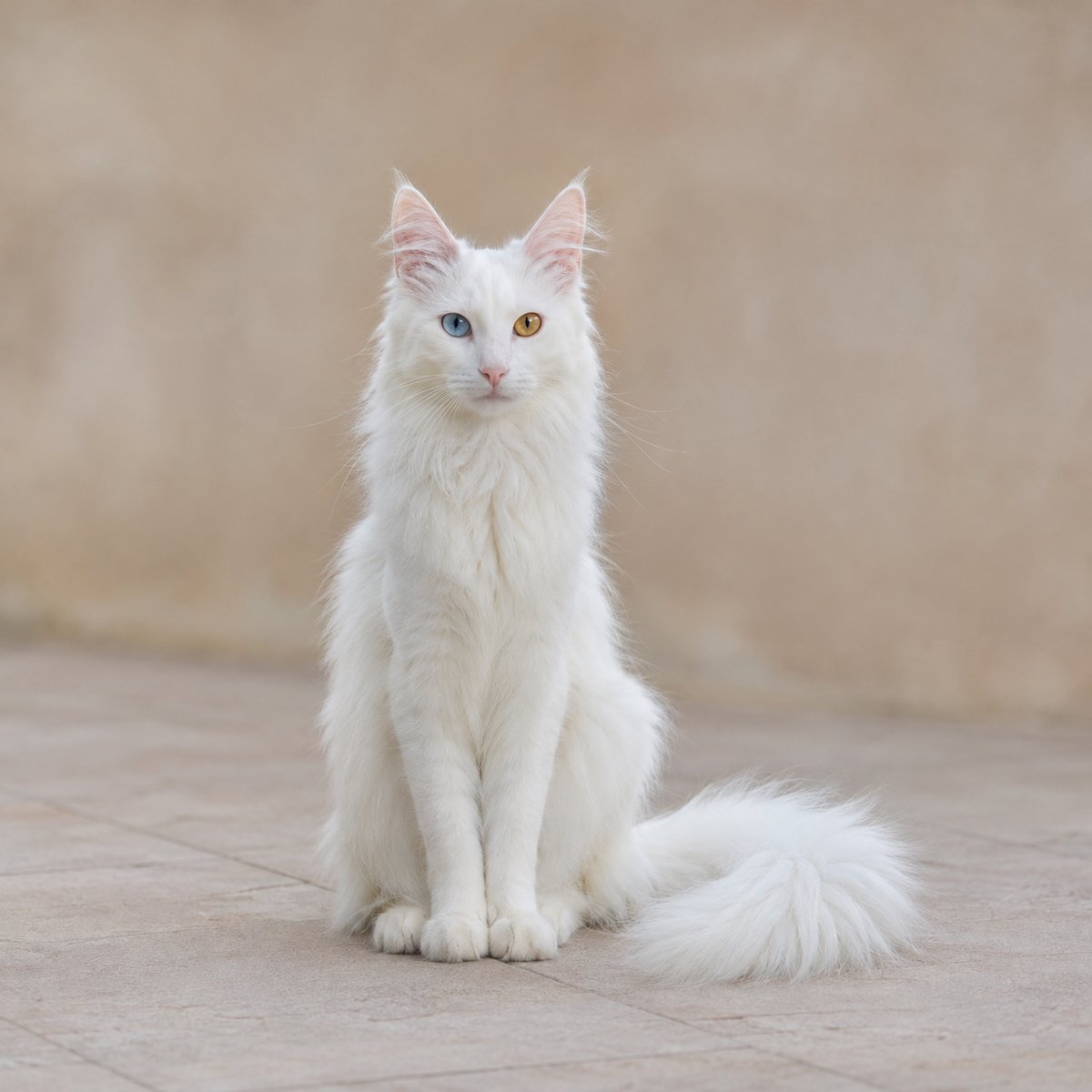
Where is she? Definitely not on the ground. The CFA Angora owners have a saying for this: If you can't find your Turkish Angora, look up. She is usually perched on the highest cupboard and watches to see if you are about to do anything exciting.
| Recognition | FIFe (EMS code TUA, recognized according to the standard since 1988), WCF, CFA, TICA and others according to the WCF list; not at the GCCF |
|---|---|
| Country of origin | Turkey |
| Weight | not specified in the FIFe standard (she-cats medium-sized, males slightly larger). According to PetMD, usually 3.6 to 6.8 kg (converted from pounds) |
| Fur | single layer, medium length, very fine with a silky sheen, longer on the ruff and tail, without undercoat; Summer fur significantly shorter |
| Colours as per standard | all colors, including any amount of white; excluding Point drawing and Chocolate, Lilac, Cinnamon and Fawn. All eye colors allowed |
| Activity | tall, easy to climb and play (editorial assessment) |
Origin
According to the CFA, the Turkish Angora is considered the oldest known long-haired breed and is probably the ancestor of other long-haired cats. Its written history dates back to the 17th century, when it came to Europe from the Middle East. In England it was later mixed so heavily with Persian cats that it almost disappeared. The Turkish government therefore started breeding in zoos in the 1930s, initially only with white animals. The first Angoras came to the USA in 1954. Today they are available in almost all colors.
Temperament
The CFA describes the Turkish Angora as one of the most interactive and affectionate breeds ever. She not only wants to be near you, but she also wants to “help” you with everything. At the same time, according to CFA, she is independent enough to stay alone during the day and will tell you everything about her day at the door in the evening. She gets along well with children and also entertains guests. A laser dot on the wall causes them to defy gravity.
Posture and activity
Plan height: scratching posts up to the ceiling, wall boards, a free space on top of the cupboard. An Angora is fast and agile and wants to play every day. Living in an apartment works well if she finds enough variety there; a secured balcony is a plus. A second, equally active cat can make sense for working people, even if, according to the CFA, the Angora can cope with being alone better than some other breeds.
Care
Because there is no undercoat, the fur hardly becomes matted. The CFA therefore considers them to be one of the easiest long-haired cats to care for. Combing two to three times a month is enough for young cats, older cats need it more often. Many people tolerate bathing well, and dripping taps fascinate them.
Health
The most important issue is congenital deafness in white cats, especially with blue eyes. PetMD quotes the Cornell Feline Health Center: 65 to 85 percent of white cats with two blue eyes are deaf. Cats with a black eye are often deaf on that side of the ear. The CFA recommends that white animals only be bred with colored ones; In some countries, a hearing test (BAER) is mandatory for white kittens. A deaf cat can live well, but it does not belong in unsecured outdoor areas. Additionally, PetMD recommends asking about family history of HCM, a thickening of the heart muscle, when breeding. If you choose a colored animal, the deafness issue is eliminated according to the CFA.
Who is the Turkish Angora suitable for?
For people and families who are looking for an elegant, playful and very affectionate cat and who give it room to climb. Also good for everyone who likes long hair but has little time for grooming.
For whom not?
For households with a lot of fragile things on high shelves and for everyone who wants a quiet sofa cat.
The cat age calculator shows how old your Turkish Angora is in human years. You can check whether the breed is right for you in the cat test. You can find name ideas in our cat names. And if you want your cat on the wall: Cat portraits from your own photo.
Frequently asked questions
Are white Turkish Angoras deaf? Not all, but the risk is high. According to Cornell Feline Health Center (quoted at PetMD), 65 to 85 percent of white cats with two blue eyes are deaf. A kitten's hearing test provides clarity.
How heavy does a Turkish Angora get? According to PetMD, usually 3.6 to 6.8 kg. The FIFe standard calls female cats medium-sized and male cats slightly larger.
Does the Turkish Angora shed a lot? The fur has no undercoat and hardly becomes matted. According to the CFA, combing young cats two to three times a month is enough.
What is the difference between Turkish Angora and Turkish Van? The Angora is delicate and elegant, the Van is strong and muscular, with color usually only on the head and tail. Both come from Turkey, but from different regions.
Read more
Quellen, abgerufen am 05.11.2026: FIFe: Rassestandards Kategorie 2 (Fassung 01.01.2026); WCF: EMS-Code-Liste mit Anerkennung je Verband (Stand 01.11.2026); CFA: Turkish Angora; PetMD: Turkish Angora Cat Breed Health and Care, tierärztlich geprüft von Barri J. Morrison, DVM.


