

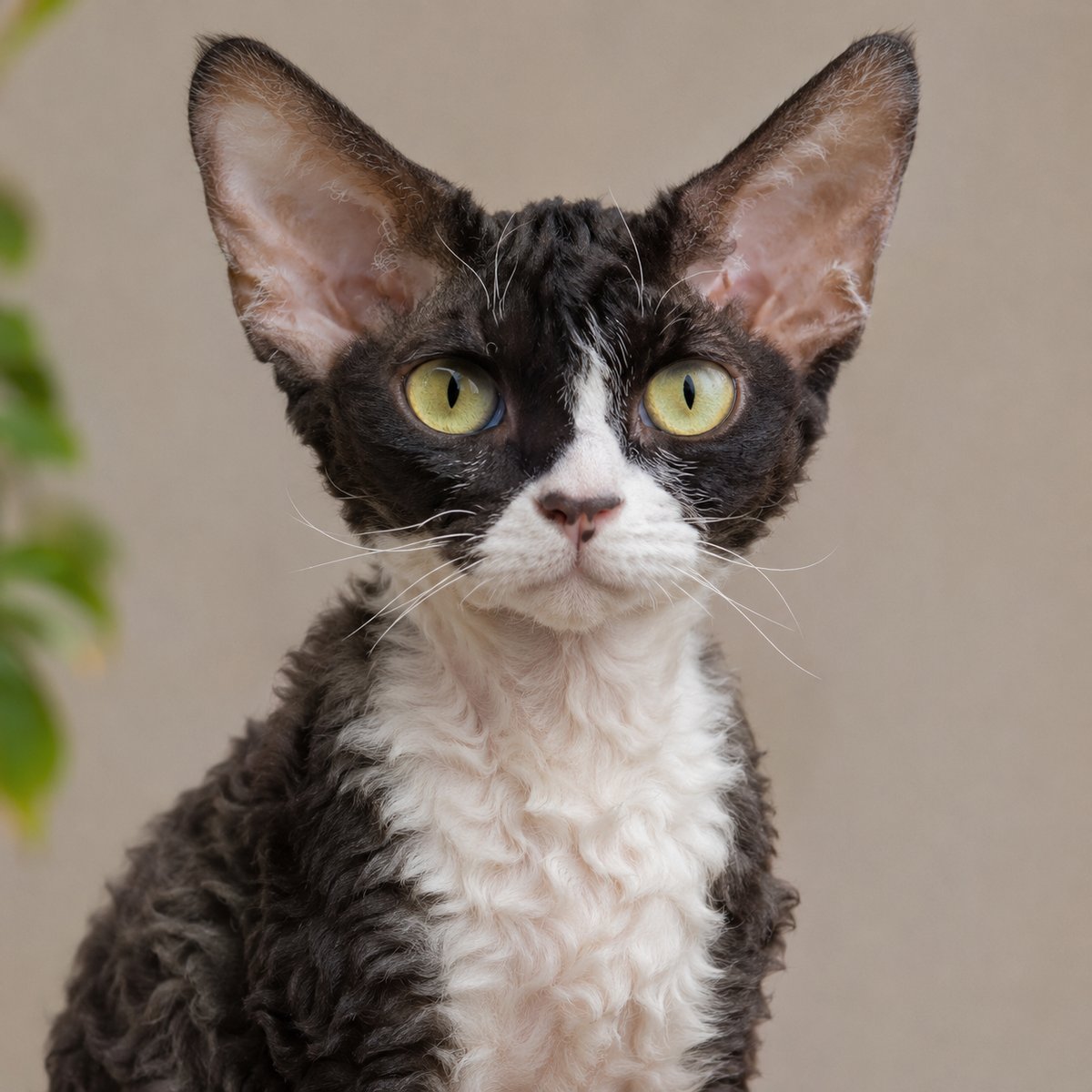
You open the closet door and a face with huge ears looks at you from above. A Devon Rex likes to sit where no other cat can go: on doors, cupboards, your shoulder. If you stroke her fur, it feels like warm, wavy velvet.
| recognition | FIFe (breed code DRX, recognized in 1968), WCF (DRX), TICA, CFA, GCCF; Recognized by all major associations according to the WCF list |
|---|---|
| Country of origin | Great Britain (Devon) |
| Weight | not specified in the FIFe standard, size “medium” there. According to GCCF and CFA, usually 6 to 9 pounds (around 2.7 to 4.1 kg), tomcats slightly heavier |
| Life expectancy | no study available; the GCCF typically states 12 to 16 years (association information) |
| fur | very short, fine and soft, wavy or curly; According to FIFe, bald spots are only permitted up to the age of 12 months. Whiskers curled |
| Colors as per standard | all colors and patterns, any white content permitted |
| activity | very high, jumps and climbs a lot (editorial assessment) |
Origin
In 1959, a curly-coated cat was born in Devon, England, the son of a stray. Beryl Cox took him in and named him Kirlee. Because the Cornish Rex had recently appeared in neighboring Cornwall, it was initially thought to have the same mutation. According to GCCF, test matings in 1961 showed that there are two different genes. The GCCF recognized the Devon Rex in 1967, the FIFe according to the standard in 1968.
beings
The FIFe describes the Devon Rex as very loving, curious, playful, sporty and cuddly. According to FIFe, she needs cat companionship for playing, cleaning and sleeping, preferably another Devon. The GCCF adds: highly active, strong jumper, wants to be everywhere and can think of stupid things when she's bored. She is rather quiet and announces herself with chirps. According to GCCF, she gets along well with children and other pets.
Attitude and employment
The apartment must be cat-proof because, according to FIFe, it jumps on doors, cupboards and in the bathtub. High climbing paths, a stable scratching post and lots of toys are mandatory. She doesn't tolerate long days alone; a second cat is almost a requirement for working people. Because her fur provides little insulation, she looks for warmth, according to the GCCF: window seats in the sun, heated loungers and warm baskets. Unprotected outdoors in the cold is not for them.
Care
The fur is delicate and breaks easily. The GCCF advises gentle care; Often it is enough to run your hand over it. Very important: the Devon Rex is not hypoallergenic. Both FIFe and GCCF emphasize that some allergy sufferers can tolerate them and others cannot. Spend time with a Devon before purchasing if you are allergic.
Health
The most well-known hereditary disease isDevon rex myopathy, also called spastic myopathy. According to UFAW (now Science for Animal Welfare), affected cats between the 3rd and 23rd week of life show muscle weakness, have difficulty lifting their heads and have swallowing problems. According to GCCF, there is a reliable genetic test. The GCCF also mentions thePatellar luxationthan more common in this breed. Caution is advised when it comes to blood type: in a review, 41 percent of Devon Rex had blood group B (Silvestre-Ferreira and Pastor 2010), which can endanger kittens if mated incorrectly. An animal welfare issue is whiskers: The Federal Ministry of Agriculture's cruel breeding report specifically mentions the Devon Rex because their whiskers are curled or may be missing, and recommends a ban on breeding cats without whiskers. Look closely at the whiskers of the parents.
Who is the Devon Rex suitable for?
For people who are at home a lot, have a second cat and are looking for a playful, very affectionate companion.
Who is it not for?
For anyone who wants a calm, independent cat, has sensitive items on every shelf or is hoping for an allergy-safe cat.
This shows how old your Devon Rex is in human yearsCat age calculator. You can check whether the breed suits youCat test. You can find name ideas in oursCat names. And if you want your cat on the wall:Cat portraits from your own photo.
Frequently asked questions
Is the Devon Rex hypoallergenic?No. According to FIFe and GCCF, she produces allergens like any cat. Some allergy sufferers can still tolerate them, but there is no guarantee.
How heavy does a Devon Rex get?According to the GCCF and CFA, usually 2.7 to 4.1 kg, tomcats a little more. She's more muscular than she looks.
What is the difference between Devon Rex and Cornish Rex?Both have wavy fur, but they come from two different genes, as test matings in 1961 showed. According to the CFA, the Devon still has some sparse guard hairs, while the Cornish lacks them.
Can a Devon Rex be kept alone?According to FIFe she needs cat company, preferably another Devon. Keeping them alone only makes sense if someone is almost always at home.
Read more
Quellen, abgerufen am 05.11.2026: FIFe: Breed Profile Devon Rex; FIFe: Standard Devon Rex (DRX), Fassung 01.01.2026; FIFe: Liste der anerkannten Rassen; WCF: EMS-Code-Liste mit Anerkennung je Verband (Stand 01.11.2026); GCCF: Devon Rex, Rasseporträt; CFA: Devon Rex; Science for Animal Welfare (UFAW): Devon Rex, Hereditary Myopathy; Silvestre-Ferreira AC, Pastor J: Feline Neonatal Isoerythrolysis and the Importance of Feline Blood Types, Veterinary Medicine International 2010; Gutachten zur Auslegung von § 11b des Tierschutzgesetzes (Verbot von Qualzüchtungen), Bundeslandwirtschaftsministerium (bereitgestellt von tierschutz.hessen.de).


