
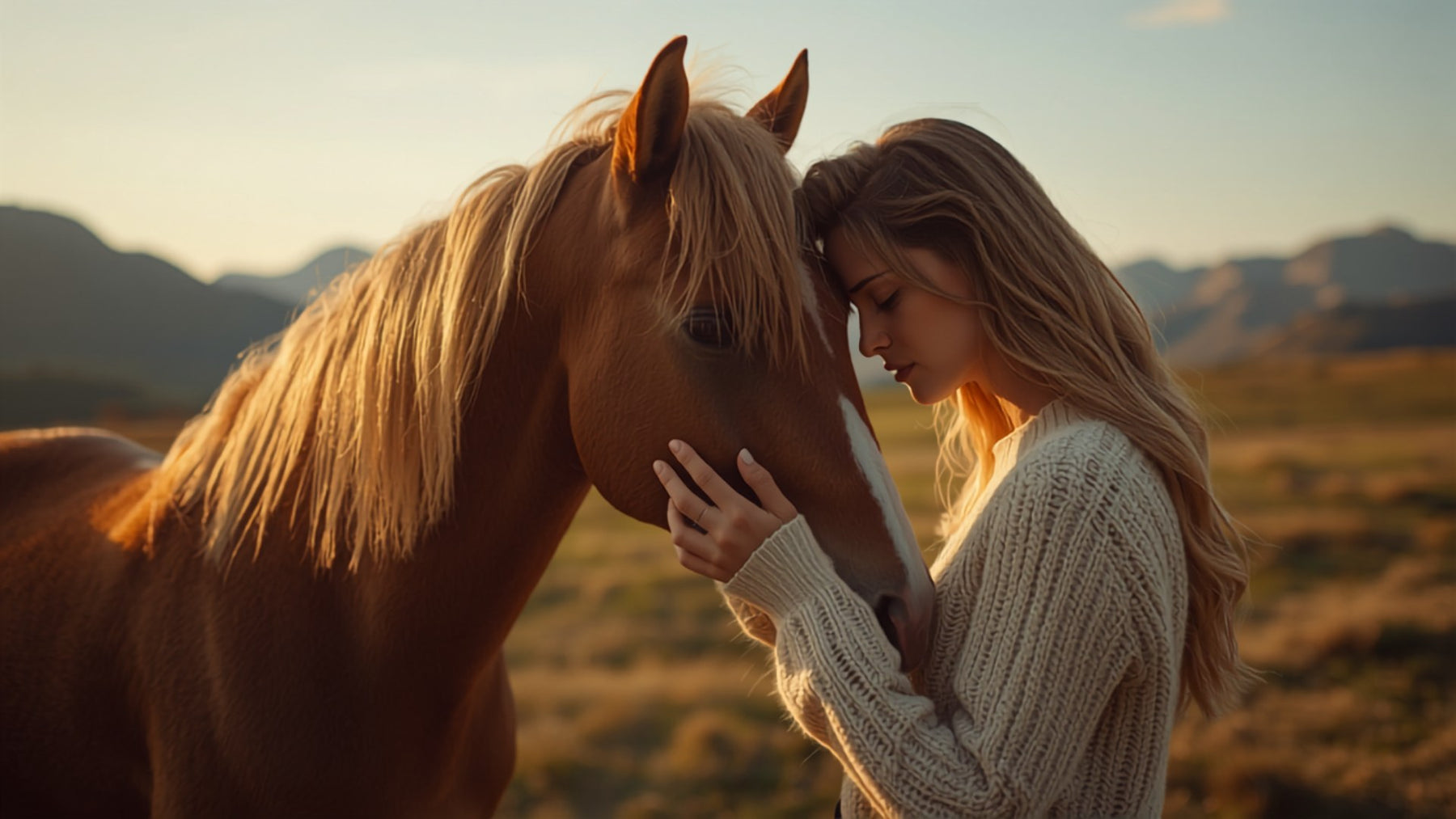
Anyone who has seen a Haflinger trot across a mountain meadow with his blond mane flying understands why this breed stays with so many people for a lifetime. The Haflinger is not a sport horse, not a competition winner, not a status symbol. He is a horse for people who want to ride without constantly fighting, and who are looking for an animal that thinks along.
But the Haflinger also has a reputation, and it is half deserved: stubborn, greedy, easygoing. Let us take an honest look.
The Haflinger at a glance
- Origin: South Tyrol and North Tyrol, named after the village of Hafling near Merano
- Height at the withers: 138 to 150 cm, which officially makes him a small horse
- Weight: 400 to 550 kg
- Colour: always chestnut, from light gold to dark liver chestnut, with a light mane and tail
- Life expectancy: 25 to 30 years, many get older
- Character: steady-nerved, people-oriented, willing to learn, independent
Character: The head is the best thing about him
Haflingers were bred as working horses in the mountains. They had to carry loads over narrow paths where one misstep could be fatal. That is why they have two qualities that have lasted to this day: they are sure-footed and calm, and they make their own decisions. People who do not understand the latter call it stubbornness.
A Haflinger who stops usually has a reason. He sees something, he does not understand the aid, or he has learned that stopping works. Anyone who sees this as a fight loses. Anyone who sees it as a conversation has a horse that follows them through thick and thin. That is exactly why Haflingers are so popular with children and beginners: they forgive mistakes without bolting.
Five points that decide his health
1. He gets fat on air and love
The Haflinger is an easy keeper, bred for sparse mountain pastures. On a lush German pasture he puts on weight within a few weeks, and overweight in this breed is the direct route to laminitis and equine metabolic syndrome. In concrete terms that means: limit grazing time, especially strictly in spring, weigh the hay, no concentrate feed except for real work, consider a grazing muzzle. Anyone who cannot keep this up ends up with a sick horse. This is the most important point in this whole article.
2. Not a horse for big adults?
A Haflinger carries an adult without any problem, his body is powerful and his back short. The rule of thumb is about 15 to 20 percent of the horse's weight including saddle, which for 500 kg is a good 80 to 90 kilos. Visually, though, a very tall rider on a 140 cm Haflinger looks like too much, and the legs reach a long way down. For leisure riding no problem, for dressage a matter of taste.
3. Athletic yes, but not in every discipline
Haflingers are excellent trekking and endurance horses, reliable driving horses and, in dressage up to class L, absolutely to be taken seriously. They can jump, but not high, and high-level eventing is not their field. Anyone with competition ambitions should know this beforehand.
4. The hooves are hard, the rest is not
The hooves are usually excellent, and many Haflingers go barefoot all their lives. On the other hand, the breed is prone to sweet itch and to mud fever in the dense feathering when the paddock is muddy. And anyone who loves the breed for the mane also has to care for it: the light mane tangles, gets full of burrs and discolours if it is not brushed regularly.
5. He needs tasks
A bored Haflinger gets creative. He opens doors, pasture fence latches and feed rooms. He needs variety, terrain, groundwork, tasks where he can think along. Round-and-round arena routine makes him dull.
Care: What he needs
- Open stable or paddock with a herd. Haflingers are social and robust; stable-box keeping without daily turnout is not species-appropriate for this breed.
- Controlled feed. See above. Hay net, grazing muzzle, weighed rations. That is love, not stinginess.
- Exercise. At least five days a week of work or extended grazing with an incentive to move.
- Regular checks. Body condition score every four weeks, blood count once a year because of metabolism.
What does a Haflinger really cost?
The purchase price is the smallest item. A well-trained, healthy leisure horse today usually costs 5,000 to 10,000 euros, foals from about 2,500 euros, competition horses considerably more. On top of that, budget a one-off 1,500 to 3,000 euros for saddle, bridle, rugs, grooming kit and the pre-purchase examination.
Realistically the running costs are 450 to 900 euros a month, in the vicinity of cities also over 1,000 euros. This is how it adds up:
- Livery: 200 to 350 euros in an open stable, 350 to 700 euros for a box with turnout, more in urban areas
- Farrier or hoof carer: every 6 to 8 weeks 40 to 60 euros barefoot, 100 to 180 euros with shoes
- Routine vet care: vaccinations, worming, dental check, converted 40 to 80 euros a month, without emergencies
- Insurance: liability 10 to 25 euros, surgery insurance 30 to 90 euros a month, urgently recommended for the Haflinger because of the laminitis risk
- Feed and supplements: hay is usually included in the livery, mineral feed and grazing muzzle 20 to 40 euros
- Riding lessons, equipment wear, trailer or transport: 50 to 200 euros depending on your ambitions
And then comes the day when something happens: colic surgery costs 5,000 to 10,000 euros, laminitis treatment over several months quickly 1,500 euros and more. Anyone without a cushion of at least 3,000 euros or without surgery insurance should wait with buying a horse. That is not a killjoy sentence, but the difference between a horse who grows old and one you cannot save in a crisis.
Who is the Haflinger right for?
For families who want a horse that carries children and adults alike. For leisure riders and trekking riders. For people who see a horse as a partner. Not for competition riders with ambitions in class S and not for people who cannot handle a no.
Frequently asked questions
Are Haflingers really stubborn? They are independent. Anyone who communicates clearly and fairly does not have a stubborn horse.
Is a Haflinger cheaper to keep than a warmblood? A little: he eats less, often goes barefoot and is robust. Livery, vet and insurance cost the same as for any other horse, though.
How long can you ride a Haflinger? With good care often into old age; 25-year-old Haflingers out on trails are not uncommon.
Golden chestnut in front of the camera
The golden colour and the light mane make the Haflinger perhaps the most beautiful horse subject for Watercolour. Photograph him backlit in the late afternoon, when the mane glows, from an angle in front with his ears pricked. Rustle a treat in your pocket, and you have the look.

The best Haflinger photo usually sits in the stable folder and is never looked at again. As a poster above the desk or on canvas in the living room you see it every day. Which formats are available is listed in the horse portraits.
Keep reading
- Buying a horse: the honest checklist: before it gets serious
- Photographing horses: so the chestnut coat does not blow out in the picture
- Giving a pet portrait as a gift: and what goes on the wall afterwards


