
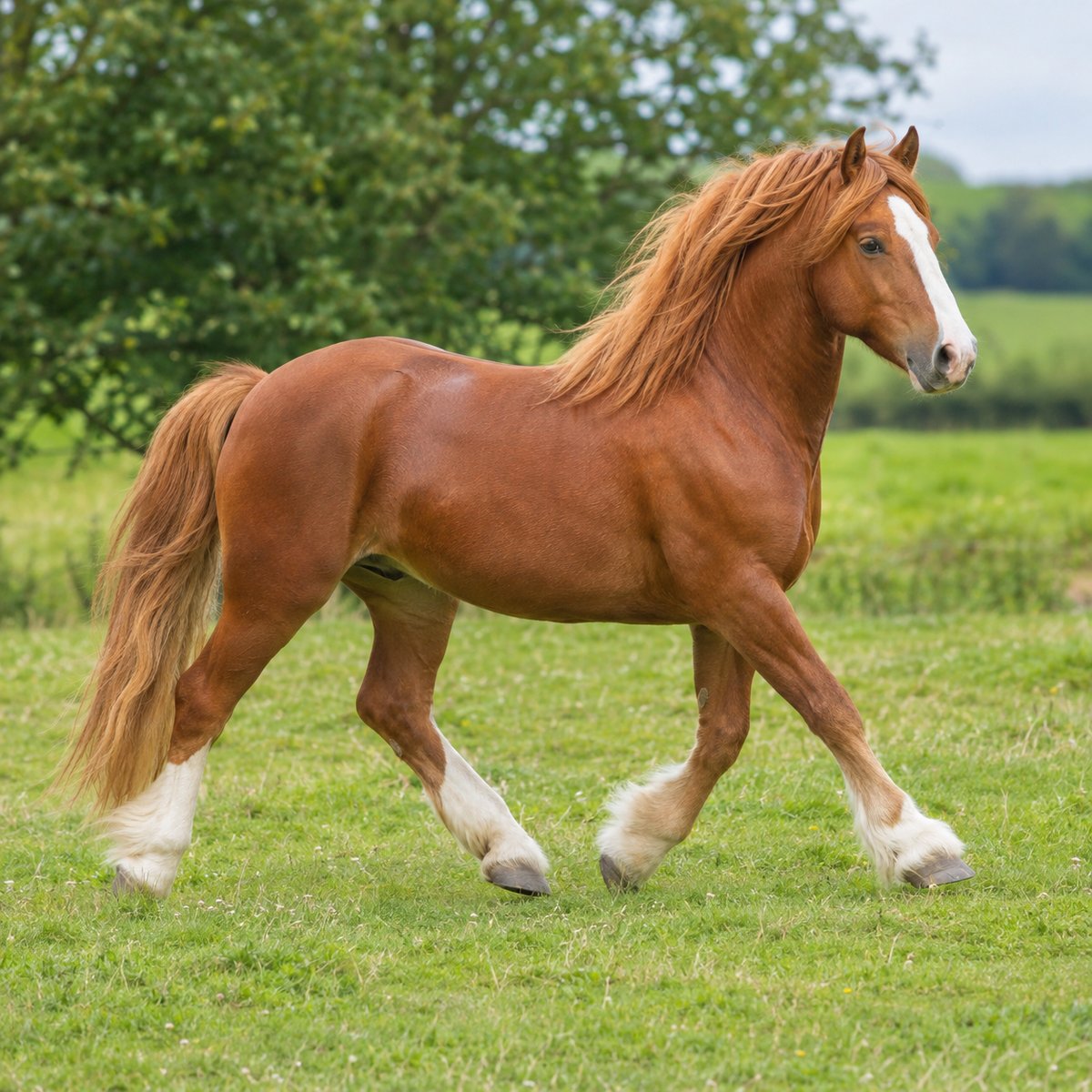
A Welsh Cob at a strong trot is an event: the front legs shoot far forward, the mane flies, and behind it a hindquarters works like an engine. He remains a pony in his head, cheeky, courageous and with a lot of his own opinion.
| Type | Bangs in cob type (C) and cob (D) |
|---|---|
| Origin | Wales, United Kingdom |
| Breeding association | Origin studbook: Welsh Pony and Cob Society (Wales); Branch breeding books etc. in the Rhenish Horse Stud Book |
| Stock size | Section C up to 137 cm; Section D over 137 cm |
| Colors | all colors except Tobiano and Overo checks |
| Usage | Riding for adults and children, driving, family and leisure horse |
Origin and history
According to the breeding program, the Section D Welsh Cob has been bred in Wales for more than 800 years. The breeding book about the origin is kept by the Welsh Pony and Cob Society in Lampeter; In Germany there are branch breeding books, such as the Rhenish Horse Stud Book. The stud book has been closed for both sections since 1960.
The sections are connected via crossing rules. For example, a foal from sections C and D will become section C if it stays up to 137 cm and section D if it grows taller. We present the smaller Welsh sections A and B in the entry on the Welsh pony.
Exterior
The original standard describes the type as strong, tough and active, with pony character and as much substance as possible. The head should be full of quality; a coarse head and a rams nose are considered very undesirable. The body is heavily muscled, with deep girdle depth and well-arched ribs, and the foundation is particularly strong. Silky hair is desirable, coarse, wiry hair is not.
The movement should be free, straight and powerful: the knee is bent and the entire front leg is stretched forward as far as possible during the trot. Section C measures up to 137 cm, section D is above that. This makes a Welsh Cob a pony or a small horse, depending on its size; the pony limit is 148 cm (FN).
Character (interior)
The breeding program describes the Welsh Cob as strong, muscular, insensitive, undemanding in attitude and handling, versatile, willing to perform, good-willed and courageous. Section C is suitable for adults and children as well as for driving sports, Section D as a family and leisure horse with a focus on adult horses and driving sports.
Courageous and willing to perform also means in everyday life: A Cob has strength and knows it. Clear, friendly training from the start is particularly important for him.
Keeping and feeding
Like all Welsh ponies, the Cob is considered undemanding. He gains weight quickly on rich pasture and concentrated feed. Ponies and light-feeding breeds are at increased risk for equine metabolic syndrome and laminitis (University of Kentucky). Pay attention to fat deposits on the mane comb and tail.
Open stables or group housing, rationed hay, limited grazing time and lots of exercise are ideal. A Cob that is driven or ridden regularly will stay in shape and happy in the head. You should keep the cat's coat clean and dry and check the skin underneath regularly.
Health
The biggest health risk in everyday life is obesity with insulin resistance and laminitis. A clumsy gait, warm hooves or a relief posture are an emergency for the veterinary practice.
We have not found any reliable published data on breed-specific hereditary diseases in Welsh Cobs. A purchase inspection that also thoroughly checks the hooves and limbs is still useful.
Who is the Welsh Cob suitable for?
For adults who are looking for a strong, versatile horse for off-road, leisure and driving sports, and for families in which parents and older children want to ride the same horse. Anyone who enjoys spirited driving has come to the right place.
Who is it not for?
For anxious riding beginners without support, because strength and courage need to be directed. And for farms with large, fat pastures without the possibility of limiting feed intake.
Furthermore: You can calculate how much a horse really costs per month with our Horse Cost Calculator, and before you buy the Horse Buying Checklist will help you. You can find ideas for the stable name in our horse names, and your own horse is available as a horse portrait from your own photo.
Frequently asked questions
How big does a Welsh Cob get? Section C up to 137 cm, section D over 137 cm height. The breeding program for Section D does not specify a fixed upper limit.
What is the difference between Welsh C and Welsh D? Section C is the Cob-type Welsh pony up to 137 cm, Section D is the Welsh Cob over 137 cm, intended as a family and adult horse and for driving.
Can an adult ride a Welsh Cob? Yes. According to the breeding program, Section C is suitable for adults and children, Section D focuses on adult horses.
Is a Welsh Cob easy to feed? It is considered undemanding. Ponies and light-feeding breeds have an increased risk of insulin resistance and laminitis.
Read more
Sources, accessed on 05.11.2026: Rheinisches Pferdestammbuch: Zuchtprogramm Welsh Ponys und Cobs (Stand 02/2025); FN: FAQ zum FEI-Ponymessen, Stand 2026; University of Kentucky Cooperative Extension: Equine Metabolic Syndrome: Is My Horse Just Fat or Is He Sick? (ID-239).


