
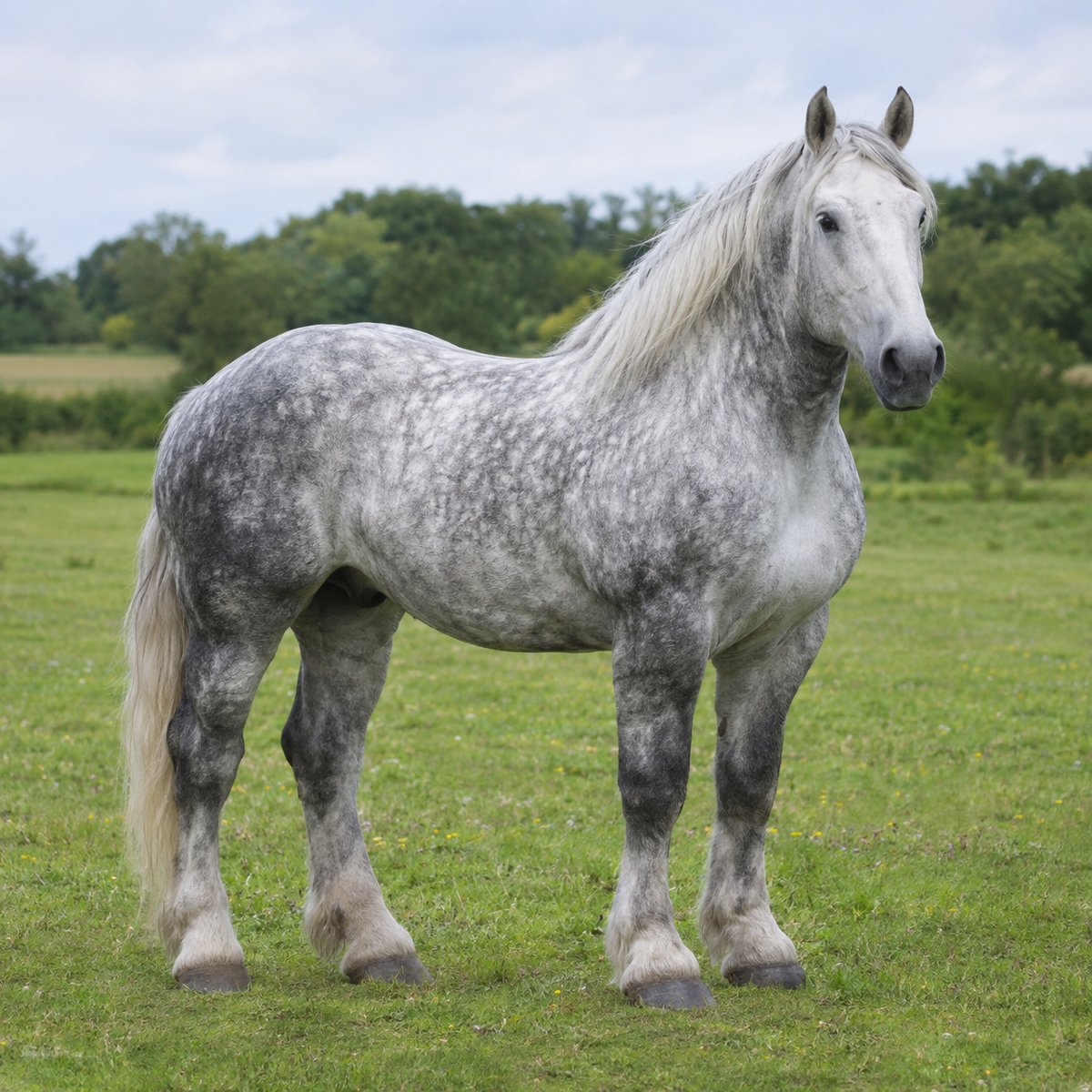
A gray giant who lowers his head while cleaning and almost falls asleep: This is how many people experience their first Percheron. Behind the serenity is a draft and workhorse from France who stands out with his fine mind. Whoever holds it needs space, powerful equipment and a keen eye for the muscles.
| Type | Cold blood, draft and work horse |
|---|---|
| Origin | France, Le Perche region |
| Breeding association | Herd book of origin in France (Haras Nationaux); Branch breeding book at the Rhineland-Palatinate-Saar Horse Breeding Association |
| Stock size | according to the breeding program 150 to 165 cm (small type) and 165 to 180 cm (large type) |
| Colors | Gray, rare black and brown |
| Usage | Draught and work horse, agriculture, parades, driving |
Origin and history
The Percheron comes from the Le Perche region in northwest France. The French stud administration keeps the stud book about the origin of the breed; in Germany there is a branch stud book at the Rhineland-Palatinate-Saar Horse Breeding Association. The breeding program describes a recognizably oriental influence that goes back to Arabs and Berbers. You can still see this today in the comparatively fine head.
In France, according to the breeding program, the breed is also used to produce foals for slaughter. In Germany, the Percheron is primarily kept in stables as a work, driving and hobby horse. The population in the German branch studbook is very small, breeders are rare.
Exterior
The breeding program requires a very massive, caliber coldblood with a broad, deep chest, short, straight back and long, slightly sloping, split croup. The head is fine, with lively eyes, fine ears and large nostrils. The limbs are strong but dry, with only a light covering of curd. It is precisely the latter that distinguishes him from the heavily hung British cold-blooded horses.
In terms of stick size, the association differentiates between a small type of 150 to 165 cm and a large type of 165 to 180 cm. The dominant color is gray, black and brown horses are less common. The movements should be rhythmic, lively and high, with a diligent step.
Character (interior)
According to the breeding program, a very sociable horse with a calm, balanced temperament that is robust and fertile is bred. In everyday life this means: A Percheron can usually be driven, cleaned and harnessed in a relaxed manner. But quiet doesn't mean that upbringing doesn't matter. A horse of this size, who has never learned to keep his distance, will simply push you to the side without any malice.
Keeping and feeding
A Percheron needs more space than a riding horse: wide doors, large boxes or a spacious open stable, stable fences and harness of the right size. He is a workhorse and does best with exercise and consistent activity.
When it comes to feeding, the following applies: roughage is the basis; you only need starch-rich concentrates if you really work hard. Breeds that are easy to feed are more prone to obesity and insulin resistance, i.e. equine metabolic syndrome with a risk of laminitis (University of Kentucky). Pay attention to fat deposits on the mane comb and tail.
Health
There is one topic you should know about the Percheron: polysaccharide storage myopathy type 1 (PSSM1), a hereditary disorder of sugar metabolism in the muscle. In an international study with samples from North America and Europe, Percherons had the highest frequency of the responsible GYS1 mutation among the breeds examined (McCue et al. 2010). Laboklin describes symptoms that are similar to a cruciate condition: muscle tremors, stiffness, sweating and reluctance to move, often after a short period of light work. The inheritance is dominant.
A genetic test from mane or tail hair shows whether your horse is a carrier. If you are a carrier or suspected, your vet will talk to you about low-starch feeding and regular, consistent exercise. Hard, sore muscles in the hindquarters or dark urine after work are a case for the veterinary practice, and immediately.
Who is the Percheron suitable for?
For people who are looking for a quiet, strong horse for driving, wood or yard work and leisurely rides and who have space for a large animal. Anyone who enjoys traditional work with horses will find a relaxed partner here.
Who is it not for?
For riders with sporting ambitions in dressage or jumping at a high level. Even those who can only offer a standard box, little exercise and a lot of concentrated feed or who don't have the budget for suitable special equipment should look at a smaller breed.
Furthermore: You can calculate how much a horse really costs per month with our Horse Cost Calculator, and before you buy the Horse Buying Checklist will help you. You can find ideas for the stable name in our horse names, and your own horse is available as a horse portrait from your own photo.
Frequently asked questions
How big does a Percheron get? The German breeding program distinguishes between a small type with a height of 150 to 165 cm and a large type with a height of 165 to 180 cm.
What color is a Percheron? It is usually gray. According to the breeding program, black and brown horses are rarer.
Do Percherons often have PSSM? In a 2010 study, Percherons had the highest frequency of the PSSM1 mutation among the breeds studied. A genetic test before purchase provides clarity.
Can you ride a Percheron? Yes. He is bred as a versatile draft and work horse, but the breeding program also takes riding and driving abilities into account.
Read more
Sources, accessed on 05.11.2026: Pferdezuchtverband Rheinland-Pfalz-Saar: Zuchtprogramm Percheron (Beschluss Mai 2023); McCue ME et al.: Estimated prevalence of the Type 1 Polysaccharide Storage Myopathy mutation in selected North American and European breeds, Animal Genetics 2010 (PubMed); Laboklin: Polysaccharid-Speicher-Myopathie Typ 1 (PSSM); University of Kentucky Cooperative Extension: Equine Metabolic Syndrome: Is My Horse Just Fat or Is He Sick? (ID-239).


