
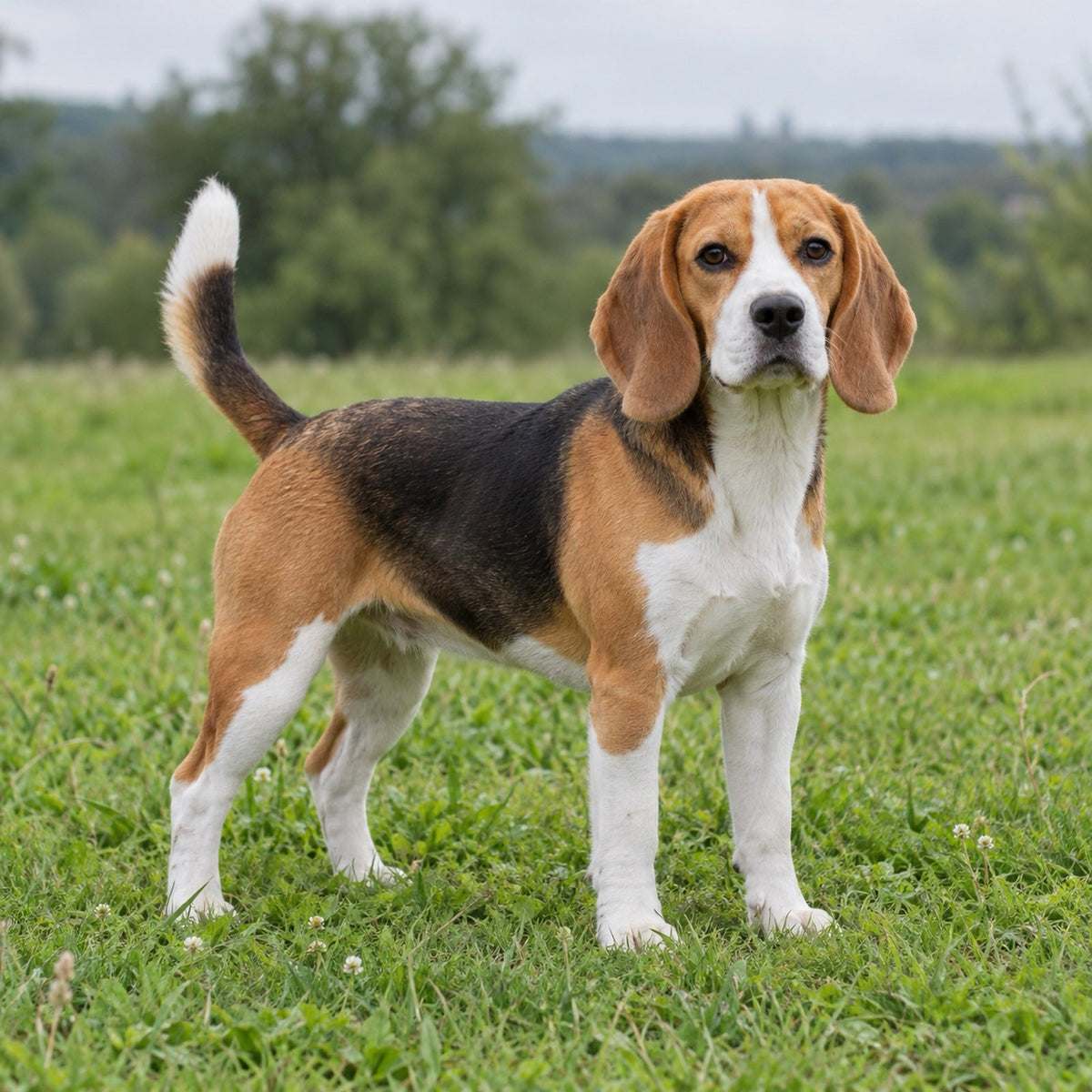
A Beagle does not go for a walk; they read. Every blade of grass tells a story, rarely ending where you want to turn back. The FCI standard states the essential job plainly: hunting, chiefly hare, by following a scent. Living with a Beagle means living with that nose.
| FCI | Group 6 (Scent hounds and related breeds), Section 1.3 Small-sized hounds, Standard No. 161, with working trial |
|---|---|
| Country of origin | Great Britain |
| Size (height at the withers) | desired minimum 33 cm, maximum 40 cm |
| Weight | not specified in the FCI standard |
| Life expectancy | median 12.5 years in a UK analysis of 584,734 dogs (McMillan et al. 2024) |
| Coat | short, dense and weatherproof |
| Colours in the standard | tricolour (black, tan and white); blue, white and tan; badger pied, hare pied and lemon pied; lemon and white; red and white; tan and white; black and white; all white. All except white may also be mottled; white tail tip |
Origins
According to the standard, Beagles were bred down from the larger Foxhound to hunt hares with people on foot. During the reigns of Henry VIII and Elizabeth I, rough-coated Beagles existed, some small enough to fit into a hunting jacket pocket. Packs still hunt in Great Britain, often organised by colleges and schools.
Temperament
The standard describes a merry scent hound, bold, active, enduring and determined, as well as alert, intelligent, even-tempered and friendly, without aggression or timidity. As a pack hound, the Beagle is sociable and enjoys company. That determination shows most clearly when a scent is more interesting than your recall.
Exercise and activity
Two hours outdoors daily is realistic, plus work for the nose: tracking, mantrailing and food searches in the garden. Off-lead exercise works only where recall is genuinely reliable. Otherwise, a long line is the safe choice.
Grooming
The short, dense, weatherproof coat needs little: weekly brushing is enough. Check the long hanging ears regularly and keep them clean.
Health
Weight is the main everyday concern. In a VetCompass study of 22,333 dogs attending UK veterinary practices, Beagles had 2.67 times the odds of being recorded as overweight compared with crossbreeds. Among breeds with the highest odds, they ranked just behind Pugs (Pegram et al. 2021). In practice: weigh food, deduct treats from the daily ration and secure the kitchen, because a Beagle finds whatever is left around. With a median of 12.5 years in McMillan and colleagues’ analysis, the breed sits slightly above crossbreeds at 12.0 years.
Who is a Beagle right for?
Sociable, active people and families who enjoy being outdoors and have a sense of humour about a friendly, stubborn dog. First-time owners prepared to train consistently can enjoy the breed too.
Who should look elsewhere?
Anyone wanting woodland off-lead freedom, and people unwilling to keep constant watch over food, bins and shopping bags. Beagles dislike being alone for long.

Read what that nose means in everyday life in the detailed Beagle breed profile. Check whether the breed suits you with the breed quiz; our book “Which Dog REALLY Suits You?” (book in German) explores it more thoroughly. For the first weeks with a puppy, there is the free Puppy Starter Pack. Bring your Beagle to the wall through our dog portraits or as a magazine-cover canvas.
Further reading
- Beagle: a nose with a dog attached, and what that means day to day
- Is my dog overweight? Assessing body condition and ideal weight
- Dog pulling on the lead: 5 mistakes almost everyone makes
Sources, accessed on 20.10.2026: FCI Standard No. 161 Beagle (fci.be, English version dated 06.10.2026; no German version is published); McMillan KM et al., Longevity of companion dog breeds: those at risk from early death, Scientific Reports 2024; Pegram C et al., Frequency, breed predisposition and demographic risk factors for overweight status in dogs in the UK, Journal of Small Animal Practice 2021.
Links to our books are affiliate links. Buying through them supports us at no extra cost to you.


